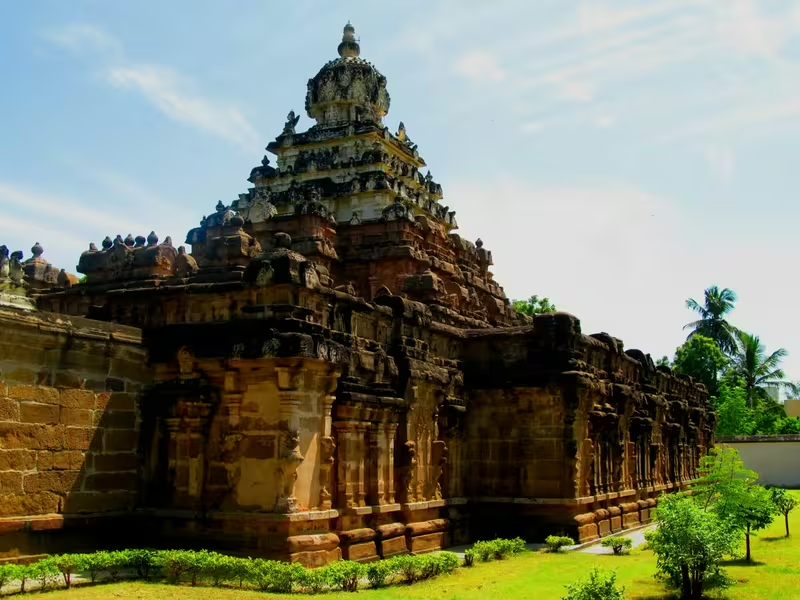
Overview
On the banks of the Vegavathy River, about 72 kilometres south-west of Chennai, Kanchipuram preserves the history of several South Indian religious and political traditions within a single urban landscape. Its temples recall Pallava experimentation, Chola patronage, Vijayanagara endowments, and the continuing life of Vaishnava, Shaiva, and Shakta worship. Its streets also belong to a living craft economy: for centuries, Kanchipuram has been associated with handloom weaving, especially silk saris.
The city is known by several names. Kanchi and Kachipedu occur in early Tamil and Sanskrit literary traditions; Sanskrit inscriptions use Kanchipuram and Kanchipura; British records commonly used Conjeeveram; and the municipality uses Kancheepuram. These variations reflect the city’s long movement between different linguistic, political, and religious settings rather than a simple change of identity.
Kanchipuram’s historical importance rests on more than its monuments. The city was a Pallava capital, a Chola administrative centre, a major Vijayanagara temple town, a site of Buddhist and Jain learning, and a contested military position during the wars of the early modern and colonial periods. It is also one of the seven Hindu cities traditionally associated with spiritual liberation. In modern Tamil Nadu, these strands meet in a city whose religious institutions, silk industry, schools, roads, and heritage buildings remain closely connected.
Etymology and Names
The oldest familiar form of the name is Kanchi. Early Tamil and Sanskrit literature also uses Kachipedu, while inscriptions from the Gupta period identify the city as Kanchipuram. Pallava inscriptions dated between 250 and 355 CE and inscriptions of the Chalukya dynasty refer to it as Kanchipura.
Several explanations for the name have circulated. One Sanskrit interpretation divides it into ka and anchi: ka is associated with Brahma and anchi with worship. In this account, the name refers to the place where Brahma worshipped Varadharaja Perumal. Another Sanskrit explanation connects kanci with a girdle and imagines the city as a girdle around the earth. A Tamil explanation connects Kanchipuram with kanchi flowers, said to have been abundant in the region.
The city is mentioned in Pāṇini’s Ashtadhyayi as Kanchi-prastha and appears in several Puranic traditions. Patanjali, the Sanskrit grammarian traditionally placed in the second or third century BCE, refers to it as Kanchipuraka in the Mahabhasya. The city is also described in early Tamil literature and in the Sanskrit literary tradition. Kalidasa, the fourth-century poet, praised it as “the best among cities,” using the expression Nagareshu Kanchi.
The name Jaina Kanchi refers to the area around Tiruparuttikundram, where important Jain monuments and inscriptions survive. During British rule, Conjeeveram became the most common English form. After independence, the municipal administration was renamed Kancheepuram, although Kanchipuram continues to be widely used for the city and district.
These names do not represent separate settlements. They show how Kanchipuram was described by grammarians, poets, dynasties, religious communities, colonial administrators, and modern institutions over a long period.
Geography and Location
Kanchipuram lies at approximately 12.8387° north and 79.7016° east. It stands on the Vegavathy River, a tributary of the Palar, in a largely flat landscape that slopes towards the south and east. The city’s elevation is about 83.2 metres above sea level.
The figures given for the city’s area vary according to administrative boundaries. One account gives 11.6 square kilometres for the urban area, while the municipality’s 2011 area is given as 36.14 square kilometres. The difference is best understood as a distinction between the built-up city and the larger municipal jurisdiction.
The region’s soils are mainly clay, with loam, clay, and sand also present. These materials were useful for construction. It has been proposed that granite used in the Varadharaja Perumal Temple may have come from the Sivaram Hills, about 10 miles east of Kanchipuram. The proposal connects the city’s geology with the construction of its large temple complexes, although the movement of the stone is presented as a historical possibility rather than a settled fact.
Kanchipuram is classified as a Seismic Zone II area. Earthquakes of up to magnitude 6 on the Richter scale may be expected. Its water systems have historically depended heavily on groundwater. The Kanchipuram block contains canals, tanks, tube wells, and ordinary wells, while the city’s municipal supply is drawn from subterranean sources associated with the Vegavathy River.
The city is conventionally divided into Big Kanchi and Little Kanchi. Big Kanchi, also called Shiva Kanchi, occupies the western and larger part of the city and contains many of the principal Shiva temples. Little Kanchi, also called Vishnu Kanchi, lies towards the east and contains many important Vishnu temples. The division is useful for understanding the distribution of sacred buildings, although the city’s religious landscape is not exclusive: major Vishnu shrines occur in and around large Shaiva and Shakta complexes, and Jain sites lie within the wider urban region.
Kanchipuram has a tropical wet-and-dry climate. Average maximum temperatures reach about 37.5°C between April and July, while average minimum temperatures fall to about 16°C between December and February. Rain comes from both the south-west and north-east monsoons, with the latter often bringing the heavier rainfall. Cyclonic storms from depressions in the Bay of Bengal can produce intense precipitation. On 10 October 1943, the highest single-day rainfall recorded in the city was 450 millimetres. On 13 November 2015, 340 millimetres of rain caused severe flooding.
The setting helped Kanchipuram develop as an inland capital. It was close enough to the wider Tamil country to remain connected to regional political and cultural networks, while its rivers, tanks, roads, and defensible urban form supported a large settlement.
Ancient History
Kanchipuram’s early history is known through literary references, inscriptions, religious traditions, and later historical reconstruction. The city is mentioned by Patanjali and appears in Sangam-era Tamil works dated around 300 BCE, including Manimegalai and Perumpāṇāṟṟuppaṭai. It is also connected in later tradition with the Dravida kingdom mentioned in the Mahabharata.
The interpretation of Kanchipuram’s place in the early Chola world is not uncontested. It has often been described as an Early Chola capital, but the historian P. T. Srinivasa Iyengar questioned this view. He argued that the Tamil culture represented in Sangam literature did not necessarily extend through the Kanchipuram district and pointed to the Sanskritic form of the city’s name. The question illustrates a wider problem in South Indian history: literary language, political control, religious affiliation, and cultural influence do not always map neatly onto one another.
By the Gupta period, Kanchipuram was sufficiently important to appear in northern imperial records. Early Gupta-period Sanskrit inscriptions describe a conflict in which King Vishnugopa of Kanchi was defeated by Samudragupta. The record places Kanchipuram within the political world known to a northern ruler, though it does not mean that the city was permanently incorporated into the Gupta Empire.
The city’s role as a centre of Buddhism and Jainism became especially visible between the first and fifth centuries. Buddhist institutions are believed to have flourished in Kanchipuram during this period. Jain teachers and institutions also became influential, receiving support from regional rulers. The city therefore belonged to several intellectual and religious networks at once.
By the time of Pallava expansion, Kanchipuram had become an established urban centre rather than a newly founded capital. The Pallavas transformed it into a fortified royal city, a centre of religious patronage, and a major place of learning.
Historical Timeline
The Pallava Capital
Kanchipuram grew decisively in importance when the Pallavas moved their capital south in the sixth century. The shift has been associated with the dynasty’s need to respond to repeated invasions from the north. Under Pallava rule, the city was fortified with ramparts and wide moats. Its roads were laid out in an organized manner, and royal and religious building projects gave it a monumental character.
The Pallava period is central to Kanchipuram’s historical identity. The city became a place where political power, temple construction, Sanskrit learning, and several competing religious traditions interacted. Buddhist and Jain institutions remained important, while Hindu temples received increasing royal support.
The reign of Mahendravarman I, dated approximately 600–630, brought the city into direct conflict with the Chalukya ruler Pulakesin II. The Chalukya army advanced through the Pallava kingdom towards the Kaveri River, but Pallava forces defended Kanchipuram. Repeated attempts to capture the city failed.
The conflict ended in a reversal of fortunes. Narasimhavarman I, the son of Mahendravarman I and ruler from approximately 630 to 668, carried the war north. The Pallavas besieged Vatapi, the Chalukya capital, and Pulakesin II was killed in the Battle of Vatapi. The victory strengthened the political prestige of Kanchipuram and the Pallava dynasty.
A Chinese traveller, Xuanzang, visited Kanchipuram in 640. He described a city approximately six miles, or 9.7 kilometres, in circumference. His account praised the bravery, piety, sense of justice, and respect for learning attributed to its people. Such descriptions should be read as observations by a foreign visitor rather than as a complete portrait of urban society, but they confirm Kanchipuram’s reputation as a major South Indian city.
Narasimhavarman II, who ruled in the early eighth century, is associated with the construction of several important temples. These include the Vaikuntha Perumal Temple, the Kailasanathar Temple, the Varadharaja Perumal Temple, and the Iravatanesvara Temple. Their architecture, inscriptions, and sculpture preserve the transition from Pallava royal authority to the later temple-centred political culture of South India.
Chola Rule
The Medieval Chola king Aditya I defeated the Pallava ruler Aparajitavarman in about 890 and incorporated Kanchipuram into the Chola realm. Under Chola control, the city became the headquarters of the northern viceroyalty. It remained politically important even though the principal Chola capital lay elsewhere.
Raja Raja Chola I, who ruled from 985 to 1014, is associated with the construction of the Karchapeswarar Temple and the renovation of the Kamakshi Amman Temple. During the Chola period, temple renovation was not simply a religious activity. It also expressed royal authority, organized land and labour, preserved ritual institutions, and connected local communities to the wider imperial administration.
Rajendra Chola I, ruling from 1012 to 1044, constructed the Yathothkari Perumal Temple according to the historical account. The Siddhantasaravali of Trilocana Sivacharya further states that Rajendra brought a group of Shaivas from his northern expedition and settled them in Kanchipuram. This tradition reflects the movement of religious specialists and the political use of settlement in the Chola period.
Kanchipuram’s temples accumulated inscriptions recording gifts, repairs, ritual arrangements, and the participation of royal and local elites. These inscriptions make the city an important place for studying how South Indian temples functioned as religious institutions and as centres of property, patronage, and public memory.
Pandya, Hoysala, Kakatiya, and Sambuvaraya Contest
Kanchipuram stood at the intersection of several competing southern powers in the thirteenth and early fourteenth centuries. In about 1218, the Pandya king Maravarman Sundara Pandyan invaded the Chola country. The Chola kingdom was saved from the full consequences of the invasion through the intervention of the Hoysala ruler Vira Narasimha II, who fought on the Chola side.
Inscriptions indicate that a strong Hoysala garrison remained in Kanchipuram until approximately 1230. The city was then recovered by the Cholas, but the restoration was temporary. Jatavarman Sundara Pandyan I took Kanchipuram in 1258, and the city remained under Pandya control until political instability followed the invasion of Malik Kafur.
The Sambuvarayars declared independence during the resulting disorder. Kanchipuram also experienced short periods of occupation by Ravivarman Kulasekhara of Venad, based in Quilon, in 1313–1314, and by the Kakatiya ruler Prataparudra II. The succession of rulers reveals the city’s strategic value: control of Kanchipuram was repeatedly sought by powers whose primary bases lay elsewhere.
Vijayanagara Rule
Kanchipuram was conquered by the Vijayanagara general Kumara Kampana in 1361 after his defeat of the Madurai Sultanate. The Vijayanagara Empire ruled the city until 1645.
The earliest inscriptions attesting to Vijayanagara authority in Kanchipuram are associated with Kumara Kampana in 1364 and 1367. They were found in the precincts of the Kailasanathar and Varadharaja Perumal temples. The inscriptions record the restoration of Hindu rituals at Kailasanathar after their abandonment during the Muslim invasions.
Vijayanagara rulers treated Kanchipuram’s temples as major religious and political institutions. Inscriptions of Harihara II, Deva Raya II, Krishna Deva Raya, Achyuta Deva Raya, Sriranga I, and Venkata II survive in the city. Harihara II made grants to the Varadharaja Perumal Temple. The record of royal support continued under later rulers and their nobles.
Kanchipuram was visited twice by Krishna Deva Raya, generally regarded as the greatest of the Vijayanagara kings. Sixteen inscriptions from his reign are found in the Varadharaja Perumal Temple. Written in Tamil, Telugu, Kannada, and Sanskrit, they preserve royal genealogies and details of contributions made by the king and his officials towards the maintenance of the shrine.
The city also belonged to the political culture of the later Vijayanagara state. Achyuta Deva Raya is said to have had himself weighed against pearls in Kanchipuram and distributed the pearls among the poor. Whether understood as a literal royal act or as a carefully preserved expression of generosity, the story reflects the ceremonial importance of the city.
After the Battle of Talikota, the Aravidu dynasty tried to preserve Vijayanagara authority in the southern territories. Venkata II, who ruled from 1586 to 1614, attempted to revive the empire, but the kingdom weakened after his death. The defeat of Sriranga III by the Golconda and Bijapur sultanates in 1646 marked the rapid collapse of effective Vijayanagara power.
Sultanates, Mughals, and Carnatic Powers
After the fall of Vijayanagara authority, Kanchipuram entered a period of political uncertainty lasting more than two decades. The Golconda Sultanate captured the city in 1672 but lost it to Bijapur three years later.
Shivaji arrived in Kanchipuram in 1676 at the invitation of the Golconda Sultanate, whose aim was to remove Bijapur forces. The campaign succeeded, and Kanchipuram remained under Golconda control until the Mughal conquest led by Aurangzeb in October 1687.
The Mughal southern campaign brought further conflict. In 1688, Mughal forces defeated the Marathas under Sambhaji, the elder son of Shivaji, in a battle near Kanchipuram. The fighting caused considerable damage to the city but strengthened Mughal control.
The movement of temple images during this period is remembered in the history of Kanchipuram’s major shrines. Priests at the Varadharaja Perumal, Ekambareswarar, and Kamakshi Amman temples, concerned about Aurangzeb’s reputation for iconoclasm, transported the images to southern Tamil Nadu. They were not returned until after Aurangzeb’s death in 1707. This episode illustrates how political instability affected ritual life and how temple communities responded to military danger.
Kanchipuram was administered within the Mughal viceroyalty of the Carnatic. During the early eighteenth century, the Carnatic began to operate with substantial independence while retaining only nominal recognition of Mughal authority. Maratha forces controlled Kanchipuram during periods of Islamic invasion in 1724 and 1740. The Nizam of Hyderabad took control in 1742.
Colonial and Modern Era
Kanchipuram became a military zone during the Carnatic Wars between the British East India Company and the French East India Company. It was also involved in the Anglo-Mysore Wars against the Sultanate of Mysore.
The Battle of Pollilur, fought in 1780 during the Second Anglo-Mysore War, took place at Pullalur near Kanchipuram. The battle became particularly known for the use of rockets by the forces of Hyder Ali of Mysore. Its location demonstrates the continuing military importance of the region during the transition from regional to colonial power.
In 1763, the British East India Company assumed indirect control from the Nawab of the Carnatic over the former Chingleput District. The district included the area of present-day Kanchipuram and Tiruvallur and was assigned to the Company to help defray the costs of the Carnatic Wars. During the Second Anglo-Mysore War, the Company brought the territory under direct control. The Collectorate of Chingleput was established in 1794.
The British commonly called the city Conjeeveram. The name remained in administrative and English usage even as Kanchipuram continued in local and historical contexts. After independence, the city developed as a municipal and district centre. The district was divided in 1997, and Kanchipuram became the capital of the newly created Kanchipuram District.
The municipality was formally constituted in 1866. It became a grade I municipality in 1947, a selection grade municipality in 1983, and a special grade municipality in 2008. In August 2021, the state government announced the proposed upgrade of Kanchipuram town to a city municipal corporation.
Political Significance
Kanchipuram’s political importance began before the Pallavas but reached its clearest expression when the dynasty made it their capital. The city’s fortifications, moats, roads, and royal temples formed a capital landscape in which defence, administration, ritual, and public display were linked.
The Pallava-Chalukya wars show why the location mattered. Pulakesin II’s armies were able to advance deep into Pallava territory, but Kanchipuram resisted capture. Its survival allowed the Pallavas to counterattack and eventually defeat the Chalukyas at Vatapi. The city was therefore not only a ceremonial capital but also a defended centre of military power.
Under the Cholas, Kanchipuram served as the headquarters of a northern viceroyalty. The city’s political role changed from that of an independent royal capital to that of an important provincial centre within a larger empire. Chola inscriptions and temple renovations reveal how imperial authority operated through local religious institutions.
The thirteenth and fourteenth centuries brought repeated contests between Cholas, Pandyas, Hoysalas, Kakatiyas, Sambuvarayars, and other powers. The city’s location made it valuable to rulers attempting to control the northern Tamil region or to project power towards the southern Deccan.
The Vijayanagara period restored Kanchipuram to a major imperial network. Temple grants and inscriptions were instruments of patronage, but they also recorded the presence of officials, military elites, merchants, and religious specialists. The city’s temples became repositories of political memory.
During the seventeenth and eighteenth centuries, the political value of Kanchipuram remained evident in the struggles among Golconda, Bijapur, the Mughals, the Marathas, Hyderabad, the Carnatic authorities, and European companies. Under British administration, its importance was expressed through the Chingleput district system rather than through royal residence.
In the modern period, Kanchipuram functions as the district headquarters and a municipality. Its political identity is therefore administrative as well as historical: the city remains a centre from which the surrounding district is governed.
Religious and Cultural Importance
Hindu Traditions
Kanchipuram is regarded in Hindu tradition as one of the Sapta Puri, the seven sacred cities associated with liberation. The Garuda Purana lists it among the cities that can provide moksha. The city is a major pilgrimage destination for Vaishnavites and Shaivites and is also central to Shaktism.
The concentration of temples has shaped the city’s physical form and its social history. Sacred tanks, processional routes, temple streets, ritual specialists, donors, artisans, and pilgrims all contributed to the development of Kanchipuram’s urban life.
The Varadharaja Perumal Temple is the largest Vishnu temple in Kanchipuram, covering about 23 acres. It contains approximately 350 inscriptions associated with Chola, Pandya, Chera, Kakatiya, Hoysala, Sambuvaraya, Kandavaraya, and Vijayanagara rulers. These inscriptions record donations and provide evidence for the political history of the city.
The temple was renovated by the Cholas in 1053 and expanded during the reigns of Kulottunga Chola I and Vikrama Chola. Later Chola rulers added another wall and gateway tower in the fourteenth century. The temple is one of the 108 Divya Desams, the sacred Vishnu shrines celebrated in Sri Vaishnava tradition.
The temple contains carved lizards, one covered in gold and another in silver, above the sanctum. Robert Clive is said to have presented an emerald necklace known as the Clive Makarakandi. It continues to be used to decorate the deity during ceremonial occasions.
The Yathothkari Perumal Temple is associated with Poigai Alvar, traditionally regarded as having been born there. The temple is mentioned in Perumpaanatrupadai and is connected in the literary tradition with Cilappatikaram, Patanjali’s works, the Tolkāppiyam, and other texts. It is celebrated in the Naalayira Divya Prabandham by Poigai Alvar, Pey Alvar, Bhutath Alvar, and Tirumalisai Alvar.
Tiru Parameswara Vinnagaram contains a three-tier shrine, with Vishnu represented in each level. The corridor around the sanctum carries sculptures associated with Pallava rule and conquest. It is regarded as the oldest Vishnu temple in the city and is attributed to the Pallava ruler Paramesvaravarman II, who ruled from 728 to 731.
Other Divya Desams in Kanchipuram include Ashtabujakaram, Tiruththanka, Tiruvelukkai, Ulagalantha Perumal Temple, Tiruppavala Vannam, and Pandava Thoothar Perumal Temple. Five further Divya Desams are located within larger temple complexes: three inside the Ulagalantha Perumal Temple, one in the Kamakshi Amman Temple, and one in the Ekambareswarar Temple.
The Ekambareswarar Temple is dedicated to Shiva and is the largest temple in the city. Its gateway tower is approximately 59 metres high, making it one of the tallest temple towers in India. The temple is one of the Pancha Bhuta Sthalams, shrines representing the five elements of nature. Ekambareswarar represents earth. The complex also contains the Chandrachuda Perumal, or Nilathingal Thundam Perumal, Divya Desam.
The Kailasanathar Temple is dedicated to Shiva and was built under the Pallavas. It is described as the oldest surviving Hindu temple in Kanchipuram and has been declared an archaeological monument by the Archaeological Survey of India. Its design includes a series of cells containing sculptures and provides important evidence for Pallava temple architecture.
The Kamakshi Amman Temple is dedicated to the goddess Parvati. The goddess is represented through a yantra, chakra, or peetam placed in front of the deity. The temple is closely associated with Adi Shankara, who is traditionally believed to have established the Kanchi Matha after the temple.
Other Pallava-period Shiva temples include the Muktheeswarar Temple, built by Nandivarman Pallava II, and the Iravatanesvara Temple, associated with Narasimhavarman Pallava II. Kachi Metrali, or Karchapeswarar Temple, Onakanthan Tali, Kachi Anekatangapadam, Kuranganilmuttam, and Karaithirunathar Temple at Tirukalimedu are among the Shiva temples in the city revered in the Tevaram, the Shaiva canonical work of the seventh and eighth centuries.
The Kumarakottam Temple, dedicated to Murugan, stands between the Ekambareswarar and Kamakshi Amman temples. This position has contributed to the development of the Somaskanda tradition. The Kandapuranam, a Tamil religious work on Murugan translated from the Sanskrit Skanda Purana, was composed in 1625 by Kachiappa Shivacharya in this temple.
The Kanchi Matha
Kanchipuram is the headquarters of the Kanchi Matha, a Hindu monastic institution. Its official history states that the matha was founded by Adi Shankara of Kaladi and traces its history to the fifth century BCE. This traditional account also holds that Adi Shankara came to Kanchipuram, established the institution as the Dakshina Moolamnaya Sarvagnya Sri Kanchi Kamakoti Peetam, and occupied a position of supremacy over other monastic institutions before his death in the city.
The history of the matha is disputed. Other historical accounts suggest that it was established in Kumbakonam, probably in the eighteenth century, as a branch of the Sringeri Matha, and later declared itself independent. The competing accounts should be distinguished from one another: the traditional chronology is part of the institution’s official memory, while the alternative interpretation is based on historical reconstruction.
Another historically important institution was the Upanishad Brahmam Mutt near the Kailasanathar Temple. It contains the mahasamadhi of Upanishad Brahmayogin, who wrote commentaries on the major Upanishads. Tradition also associates the matha with the renunciation of Sadasiva Brahmendra.
Buddhism
Buddhism is believed to have flourished in Kanchipuram between the first and fifth centuries. The city is associated with Āryadeva, a successor of Nāgārjuna at Nalanda, and with the Buddhist thinkers Dignaga, Buddhaghosa, and Dhammapala.
A popular tradition identifies Bodhidharma, the Buddhist monk associated with the foundation of Shaolin Kung Fu, as the third son of a Pallava king from Kanchipuram. Other traditions place his origins elsewhere in Asia. The Kanchipuram connection is therefore best presented as a tradition rather than as an established fact.
Buddhist institutions from Kanchipuram are said to have helped spread Theravada Buddhism among the Mon people of Myanmar and Thailand. In turn, religious connections linked Kanchipuram with wider networks of Buddhist movement across the Bay of Bengal.
Bronzes discovered at Kurkihar near Gaya in Bihar contain inscriptions indicating that many donors came from Kanchi. These records suggest that Kurkihar was an important destination for visitors from Kanchipuram between the ninth and eleventh centuries.
Jainism
Kanchipuram was a major centre of Jainism and is associated with teachers such as Samantabhadra and Akalanka. Jainism is traditionally said to have been introduced to the city by Kundakundacharya in the first century and to have spread through the influence of Akalanka in the third century.
The Kalabhras, rulers of Kanchipuram before the Pallavas in the historical tradition, are described as followers of Jainism. Jainism gained from royal patronage, and several Pallava rulers, including Simhavishnu, Mahendravarman, and Simhavarman, are associated with the religion before the rise of the Nayanmars and Alvars in the sixth and seventh centuries.
Mahendravarman I’s conversion from Jainism to Hinduism under the influence of the Nayanmar saint Appar is presented as a turning point in the city’s religious history. Shaivism and Vaishnavism later gained renewed strength under the influence of Adi Shankara and Ramanuja respectively. Later Chola and Vijayanagara rulers continued to tolerate Jain practice, and Jain communities remained active in Kanchi.
The original Jina Kanchi institution was located in Kanchipuram. Its former site is represented by the Trilokyanatha and Chandraprabha Temple at Tiruparthikundram. This twin Jain temple contains inscriptions of the Pallava king Narasimhavarman II and the Chola kings Rajendra Chola I, Kulottunga Chola I, and Vikrama Chola, along with Kannada inscriptions of Krishna Deva Raya. The temple is maintained by the Tamil Nadu archaeological authorities.
The Jina Kanchi Matha later moved to Melsithamur near Gingee in the sixteenth century. Several historic Jain sites survive in villages around Kanchipuram, where Jain communities are still present.
Other Religious Communities
Kanchipuram has two historic mosques. One stands near the Ekambareswarar Temple and was built during the rule of the Nawab of Arcot in the seventeenth century. Another stands near the Vaikunta Perumal Temple and shares a common tank with the Hindu temple. Muslims also participate in festivals associated with the Varadharaja Temple.
Christ Church is described as the oldest Christian church in the city. It was built in 1921 by a British man named Mclean. The building uses a Scottish-style brick design with arches and pillars.
Education and Intellectual Life
Kanchipuram’s reputation as a centre of learning is expressed through the term ghatikasthanam, meaning a place of learning. Its educational history includes Hindu, Buddhist, Jain, Sanskrit, Tamil, and monastic institutions.
During the early centuries, Buddhist monasteries acted as centres of Buddhist education. With the revival of Hindu traditions under Mahendravarman I, Hindu education gained prominence, and Sanskrit became an official language of intellectual and political life. Jain teachers and institutions also contributed to the city’s scholarly culture.
The city’s temples functioned as more than places of worship. Their inscriptions preserve records of religious instruction, donations, ritual specialists, political genealogy, and institutional management. Literary traditions associated with the city also connect it with grammar, philosophy, theology, and devotional poetry.
In the modern period, Kanchipuram has a network of schools and higher educational institutions. In 2011, the city had 49 registered schools, 16 of them run by the municipality. Night schools were opened for children employed in the silk-weaving industry. In December 2001, these schools were educating 127 children and had 260 registered students from September 1999.
Sri Chandrasekharendra Saraswathi Viswa Mahavidyalaya and Chettinad Academy of Research and Education are deemed universities in Kanchipuram. Pachaiyappa’s College for Men, founded by Vallal Pachaiyappar, stands on the banks of the Vegavathy River and offers undergraduate and postgraduate courses. It is described as the only government-aided institution in Kanchipuram Taluk.
The city also has an Indian Institute of Information Technology established through a public-private partnership, two medical colleges, six engineering colleges, three polytechnic institutes, and six arts and science colleges. The Arignar Anna Memorial Cancer Institute and Hospital was established in 1969 and is operated by the Tamil Nadu government’s health department. Meenakshi Medical College is privately owned.
Modern educational development has not replaced the city’s older intellectual identity. Instead, universities, professional colleges, municipal schools, temple institutions, and monastic traditions now coexist within the same historic urban environment.
Economic Role
The traditional occupations of Kanchipuram are silk-sari weaving and agriculture. In 2008, approximately 5,000 families were estimated to be involved in sari production. The wider industrial economy included cotton production, light machinery, electrical-goods manufacturing, food processing, rice milling, yarn production, and dyeing.
Kanchipuram’s economy is closely tied to its temples and pilgrimage culture. Tourism supports hotels, restaurants, local transport, retail, and guide services. The city’s reputation as the City of Thousand Temples has also helped make it a major domestic tourist destination and a growing destination for foreign visitors.
The modern municipal area contains residential, commercial, industrial, and transport zones. About 416 hectares are used for residential properties, largely around temples. Commercial uses cover approximately 62 hectares, while industrial development occupies about 65 hectares. These industrial areas contain handloom-spinning, silk-weaving, dyeing, and rice-production units. Roads, railways, bus stands, and related transport infrastructure use approximately 89.06 hectares.
Kanchipuram Silk
Kanchipuram is one of India’s best-known handloom silk centres. The trade is traditionally associated with the migration of weavers. One account states that Raja Raja Chola I invited weavers from Saurashtra in Gujarat to settle in Kanchi. The craft expanded further with the movement of weavers from Andhra Pradesh during the Vijayanagara period.
The city’s weaving economy suffered disruption when Kanchipuram was attacked during the French siege of 1757. Weaving revived towards the end of the eighteenth century and continued as a major occupation.
In 2005, “Kanchipuram Silk Sarees” received a Geographical Indication tag. The designation recognized the regional identity of the product, although the industry continued to face challenges from weak marketing and duplicate products. The weaving community’s economic difficulties show that heritage crafts can remain culturally prominent while the people who produce them face serious market pressures.
The sari industry is therefore both a historical inheritance and a contemporary livelihood. It links Kanchipuram’s dynastic past to the working lives of thousands of families, while also connecting the city to national and international markets.
Monuments and Architecture
Kailasanathar Temple
The Kailasanathar Temple is the oldest surviving Hindu temple in Kanchipuram according to the historical account. Built under the Pallavas and dedicated to Shiva, it is an archaeological monument under the Archaeological Survey of India.
Its design includes a main shrine surrounded by a series of sculpted cells. The temple is especially valuable for the study of Pallava architecture, because it preserves an early stage in the development of the stone-built temple complex. Its sculptures and spatial organization show the relationship between royal patronage, Shaiva devotion, and architectural experimentation.
The temple also played a role in the city’s political history. Inscriptions associated with Kumara Kampana record the re-institution of Hindu rituals after their abandonment during the Muslim invasions.
Vaikunta Perumal Temple
The Vaikunta Perumal Temple, dedicated to Vishnu, is associated with the Pallava period and is among the city’s major monuments. It preserves architectural and sculptural evidence of the Pallava royal world.
The shrine forms part of Kanchipuram’s wider Vaishnava landscape, in which temple architecture, royal genealogy, devotional literature, and ritual practice are closely linked. Its importance is reinforced by the city’s place within Sri Vaishnavism.
Varadharaja Perumal Temple
The Varadharaja Perumal Temple is one of Kanchipuram’s largest and most historically documented shrines. Its 23-acre complex contains hundreds of inscriptions recording donations and political developments under successive dynasties.
Chola renovations and later additions created a monumental complex that continued to grow under Vijayanagara patronage. The temple’s multilingual inscriptions demonstrate that Kanchipuram was connected to Tamil, Telugu, Kannada, and Sanskrit political worlds. They also show how rulers and local elites supported the maintenance of a major shrine.
The temple is a Divya Desam and remains one of the principal pilgrimage destinations in the city.
Ekambareswarar Temple
The Ekambareswarar Temple dominates northern Kanchipuram. Dedicated to Shiva, it is the city’s largest temple and has a 59-metre gateway tower. As one of the Pancha Bhuta Sthalams, it represents the element of earth.
The temple complex also contains the Nilathingal Thundam Perumal shrine, demonstrating how Shaiva and Vaishnava sacred spaces can coexist within the same monumental enclosure. This shared landscape is characteristic of Kanchipuram, where sectarian traditions are distinct but physically intertwined.
Kamakshi Amman Temple
The Kamakshi Amman Temple is the city’s principal Shakta shrine. The goddess is represented through a yantra or chakra placed before the deity. The temple’s association with Adi Shankara is central to its religious memory and to the history claimed by the Kanchi Matha.
The temple was renovated during the Chola period and later became one of the shrines whose images were moved during the political disturbances of the late seventeenth century. Its history therefore combines ritual symbolism, royal patronage, monastic traditions, and responses to military threat.
Jain Temples at Tiruparthikundram
The Trilokyanatha and Chandraprabha Temple at Tiruparthikundram is a twin Jain temple near Kanchipuram. Its inscriptions span Pallava, Chola, and Vijayanagara periods. They provide evidence for the continuing presence of Jain communities and for the city’s place in the wider history of Jain religious institutions.
The temple also represents the relationship between Kanchipuram’s urban centre and the settlements surrounding it. The city’s religious history cannot be understood only through its largest Hindu monuments; Jain sites in the surrounding region preserve another major layer of its past.
Famous Personalities
Pallava Rulers
Mahendravarman I defended Kanchipuram against the Chalukya ruler Pulakesin II and is associated with the city’s transition towards greater Hindu architectural and educational prominence. His son Narasimhavarman I completed the reversal of the Chalukya invasion by conquering Vatapi and killing Pulakesin II in battle.
Narasimhavarman II is remembered as a major builder of Kanchipuram’s temples, including the Kailasanathar, Vaikuntha Perumal, Varadharaja Perumal, and Iravatanesvara temples. These rulers made the city a centre of both political power and architectural culture.
Religious Teachers and Scholars
Adi Shankara is closely associated with Kanchipuram through the traditions of the Kamakshi Temple and the Kanchi Matha. The historical date and institutional origins of the matha are debated, but his importance in the city’s religious memory is unquestioned.
Ramanuja is connected to the revival of Vaishnava traditions in the broader religious history of Kanchipuram. The city’s Divya Desams, Alvar traditions, and temple institutions form an important setting for Sri Vaishnavism.
Poigai Alvar is associated with the Yathothkari Perumal Temple. Other Alvars whose devotional poetry celebrates Kanchipuram’s shrines include Pey Alvar, Bhutath Alvar, and Tirumalisai Alvar.
Kanchipuram’s Buddhist intellectual associations include Āryadeva, Dignaga, Buddhaghosa, and Dhammapala. Jain teachers associated with the city include Samantabhadra and Akalanka.
C. N. Annadurai
C. N. Annadurai, the writer, politician, and founder of the Dravida Munnetra Kazhagam, was born and raised in Kanchipuram. He became the first member of a Dravidian party to serve as chief minister of Tamil Nadu and the first non-Congress leader to form a majority government in post-colonial India.
His association with Kanchipuram connects the city’s ancient and medieval history to the political transformation of modern Tamil Nadu.
Decline and Revival
Kanchipuram did not experience a single, final decline. Instead, its role changed repeatedly. The city lost its position as an imperial capital when Pallava power was replaced by Chola rule, yet it remained a major administrative and religious centre. Later, Pandya, Hoysala, Kakatiya, Sambuvaraya, and Vijayanagara control altered its political setting without eliminating its importance.
The fall of Vijayanagara brought prolonged instability. Golconda, Bijapur, Mughal, Maratha, Hyderabad, Carnatic, and European powers competed for control of the region. Warfare damaged the city and disrupted temple rituals. The removal of temple images during the Mughal period and the destruction associated with the 1757 French siege affected religious and economic life.
Yet several institutions allowed Kanchipuram to recover. Temples continued to attract pilgrims and receive patronage. Weaving re-emerged after the eighteenth-century disruption. Under British administration, the city became part of a stable district system, even though it no longer served as a royal capital.
In the modern period, revival has taken several forms: the continuation of handloom weaving, the expansion of schools and colleges, improvement of road and rail connections, and the recognition of Kanchipuram as a heritage city under the HRIDAY scheme of the Government of India.
Preservation remains complicated. The city is not a frozen monument but a living urban settlement. Religious activity, residential growth, tourism, transport, craft production, water management, and heritage protection all compete for space. The survival of Kanchipuram’s history depends on maintaining this living relationship rather than treating temples as isolated structures.
Modern City
Kanchipuram is the administrative headquarters of Kanchipuram District and is governed by a special grade municipality constituted in 1947. The municipality’s functions include general administration, engineering, revenue, public health, city planning, and information technology. In the 2011 municipal account, it contained 51 wards.
Population figures vary according to the boundary used. The 2011 census account gives 164,384 for the city, while another municipal figure gives 234,353 and the wider extract gives an estimated 232,816. These differences reflect varying administrative definitions rather than a single consistent urban boundary.
The 2011 census account records a sex ratio of 1,005 females per 1,000 males and a literacy rate of 79.51 percent. Scheduled Castes accounted for 3.55 percent of the population and Scheduled Tribes for 0.09 percent. The religious census recorded a large Hindu majority, with Muslim, Christian, Jain, Sikh, Buddhist, and other communities also present.
The city’s modern workforce includes weaving, agriculture, household industries, manufacturing, transport, tourism, hospitality, and public services. In 2011, 61,567 workers were recorded across cultivators, agricultural labourers, household industries, other occupations, and marginal work.
Kanchipuram is connected to Chennai and other South Indian cities by the Chennai–Bangalore National Highway, which passes near the city. State transport services connect it to Chennai, Bangalore, Villupuram, Tirupati, Tiruvannamalai, Vellore, Salem, Coimbatore, Pondicherry, and other destinations. The city’s railway station lies on the Chengalpattu–Arakkonam line. Daily services run to Pondicherry and Tirupati, with express services to Madurai and Nagercoil on a less frequent schedule.
Chennai International Airport is the nearest domestic and international airport, approximately 72 kilometres away. A proposed New Chennai International Airport is planned at Parandhur near Kanchipuram.
The municipality draws water from subterranean sources associated with the Vegavathy River. Underground drainage covers a large proportion of the city’s roads, while solid waste is collected from five points across the urban area. The city’s infrastructure therefore continues to address the practical pressures created by pilgrimage, industry, residential growth, and seasonal rainfall.
Kanchipuram receives approximately 800,000 pilgrims annually according to the 2001 account. Visitors come for its temples, festivals, architecture, religious traditions, and silk products. The city has been selected as a heritage city under the HRIDAY heritage-development scheme, reflecting national recognition of its built and cultural heritage.
Timeline
Early Literary References
Kanchipuram appears in the literary and grammatical traditions associated with Patanjali and early Tamil texts.
Gupta-Period Reference
Sanskrit records identify Kanchipuram and describe the defeat of King Vishnugopa by Samudragupta.
Pallava Capital
The Pallavas moved their capital south to Kanchipuram and developed its fortifications, roads, temples, and institutions of learning.
Xuanzang Visits Kanchipuram
The Chinese traveller described the city as approximately six miles in circumference and praised its people’s learning and piety.
Pallava Victory at Vatapi
Narasimhavarman I defeated the Chalukyas at Vatapi after Kanchipuram had resisted Pulakesin II’s invasions.
Pallava Temple Building
The reign of Narasimhavarman II is associated with major temples including the Kailasanathar and Vaikuntha Perumal temples.
Chola Conquest
Aditya I defeated Aparajitavarman and brought Kanchipuram into the Chola kingdom.
Chola Renovation
The Varadharaja Perumal Temple was renovated during the Chola period.
Pandya Control
Jatavarman Sundara Pandyan I took Kanchipuram after the city had been contested by Cholas, Pandyas, and Hoysalas.
Vijayanagara Conquest
Kumara Kampana conquered Kanchipuram after defeating the Madurai Sultanate.
Vijayanagara Inscriptions
An inscription of Kumara Kampana records the restoration of Hindu rituals at the Kailasanathar Temple.
Golconda Occupation
The Golconda Sultanate gained control of Kanchipuram during the political turmoil following the decline of Vijayanagara.
Mughal Conquest
Kanchipuram was incorporated into the Mughal sphere after Aurangzeb’s southern campaign.
Battle Near Kanchipuram
Mughal forces defeated the Marathas under Sambhaji in a battle near the city.
French Siege
The city was damaged during the French siege, after which its weaving economy later recovered.
Company Administration
The British East India Company assumed control of the former Chingleput District from the Nawab of the Carnatic.
Battle of Pollilur
The Battle of Pollilur, known for Mysorean rocket use, was fought at Pullalur near Kanchipuram.
Municipal Constitution
The Kanchipuram municipality was formally constituted.
British Census
The city’s population was recorded as 46,164 in the British census.
Municipal Upgrade
Kanchipuram became a grade I municipality in the year of Indian independence.
District Reorganization
The district was divided and Kanchipuram became the capital of the newly created Kanchipuram District.
Silk Geographical Indication
Kanchipuram Silk Sarees received a Geographical Indication tag.
Proposed Corporation Status
The Tamil Nadu government announced the proposed upgrade of Kanchipuram town to a city municipal corporation.
See Also
- Kailasanathar Temple
- Vaikunta Perumal Temple
- Varadharaja Perumal Temple
- Ekambareswarar Temple
- Kamakshi Amman Temple
- Kumarakottam Temple
- Trilokyanatha-Chandraprabha Jain Temple
Further Reading
- Naalayira Divya Prabandham, the Vaishnava devotional canon associated with Kanchipuram’s Divya Desams.
- Tevaram, the Shaiva canonical work celebrating several temples in the city.
- Inscriptions of the Pallava, Chola, Vijayanagara, and other dynasties preserved in Kanchipuram’s temples.
- Kancheepuram Municipality and Kanchipuram District Administration records.