Overview
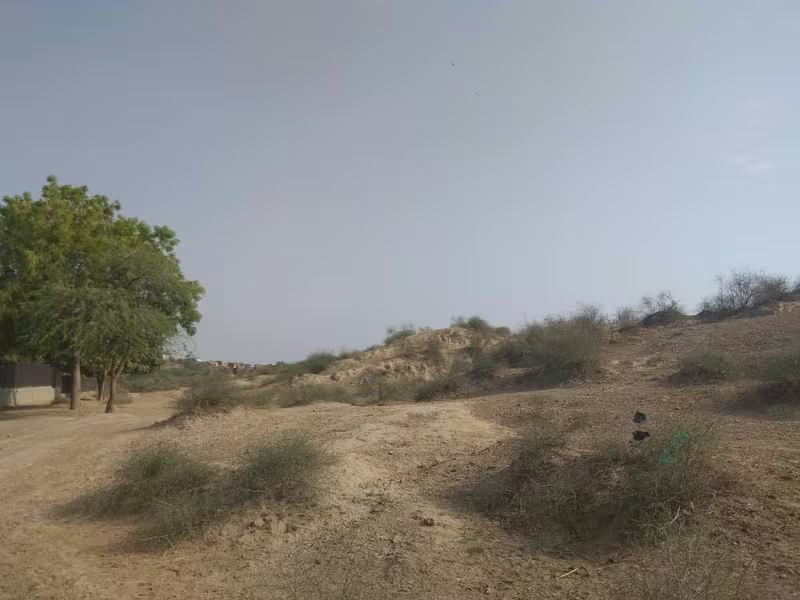
At least five closely integrated mounds at Rakhigarhi preserve the remains of a large urban settlement that flourished during the mature phase of the Indus Valley Civilisation. The site lies in present-day Haryana, about 150 kilometres northwest of Delhi and approximately 27 kilometres from the seasonal Ghaggar River. Its archaeological remains extend across a much wider area than the main settlement, creating an important distinction between the size of the entire site complex and the extent of the urban habitation at any one time.
Rakhigarhi was occupied over a long span. The earliest levels are associated with pre-Harappan settlement, followed by early Harappan and mature Harappan phases. Archaeological work has identified residential areas, roads, drains, fortification, storage facilities, workshops, ornaments, seals, weights, ritual structures, and a cemetery. Together, these discoveries show a community capable of organising labour, managing water and waste, producing specialised goods, and participating in exchange networks.
The site is also important because its history is still incomplete. Excavation began in the twentieth century but has covered only a small part of the settlement. Several mounds have been damaged by cultivation, soil removal, construction, and the removal of artefacts. The continuing work at Rakhigarhi therefore has two purposes: to understand one of the largest settlements associated with the Harappan world and to preserve what remains of it.
Etymology and Names
The archaeological site is commonly known as Rakhigarhi or Rakhi Garhi. The latter form reflects the Hindi name of the modern village. The mounds themselves are identified using the abbreviation RGR followed by a number, such as RGR-1, RGR-2, and RGR-7.
The numbered mounds do not all represent the same kind of place or the same period of occupation. RGR-1 through RGR-5 are generally treated as the principal group of closely integrated mounds associated with the mature urban settlement. RGR-6, also called Arda, lies outside this group and appears to have belonged primarily to an older settlement. RGR-7 was used as a cemetery or burial ground during the mature Harappan phase. Later discoveries added RGR-8 and RGR-9, while the site is now discussed as a complex of eleven numbered mounds.
This arrangement matters because the largest estimates for Rakhigarhi include outlying remains that may not have formed a single urban settlement at one moment. The archaeological landscape was probably made up of settlements and activity areas with different histories rather than one uniformly occupied city extending across the whole 300–350-hectare area.
Geography and Location
Rakhigarhi stands in the Ghaggar plain of Haryana. The site is around 27 kilometres from the seasonal Ghaggar River and has been associated by Jane McIntosh with the valley of the prehistoric Drishadvati River, which is described as having originated in the Siwalik Hills. The Chautang is identified as a tributary of the Sarsuti, which in turn is a tributary of the Ghaggar.
The riverine setting helped shape the settlement’s history. Although the present Ghaggar is seasonal, the wider plain supported communities over many centuries. The location formed part of a broader network of settlements distributed along the Ghaggar-Hakra river course and neighbouring plains. These included Bhirrana, Kunal, Siswal, Banawali, Balu, and Kalibangan.
Rakhigarhi’s location also placed it within a regional system of movement and exchange. Archaeological evidence from the settlement includes standardised weights, seals, jewellery, semi-precious stones, and craft tools. These objects do not by themselves document every route used by the inhabitants, but they indicate participation in economic practices shared across the Harappan world.
Ancient History
Earliest occupation
The earliest occupation at Rakhigarhi predates the mature Indus Valley Civilisation. Chronologies for the lowest levels remain tentative, with one proposed bracket extending from approximately 6000 BCE through later fourth-millennium BCE phases. RGR-6, or Arda, has produced dates associated with a pre-formative Sothi phase. Two published radiocarbon determinations from this mound were approximately 6420 ± 110 and 6230 ± 320 years before present, converted in the archaeological discussion to about 4470 ± 110 BCE and 4280 ± 320 BCE.
Other dates provided by the Archaeological Survey of India place occupation on RGR-6 at roughly 5,640 and 5,440 years before present. These dates help establish that settlement in the Rakhigarhi area began well before the mature urban phase. They also support the interpretation that not every mound belonged to one continuously occupied city.
Early Harappan development
The early Harappan period at Rakhigarhi is represented by residential occupation on several mounds. The chronology generally assigned to this phase is about 3300–2600 BCE, although individual dates vary according to mound and archaeological layer. RGR-1 and RGR-2 have produced dates associated with the early Harappan period, including determinations around 5,200 and 4,570 years before present.
During this period, the settlement developed the foundations of a more complex urban community. Pottery from Rakhigarhi has similarities with material found at Kalibangan and Banawali. The presence of specialised tools, ornaments, and production areas suggests that the inhabitants were not simply farming communities living in isolated houses. They were participating in wider cultural and economic patterns that later became more visible in the mature Harappan period.
Mature Harappan settlement
The mature Harappan phase, conventionally dated to about 2600–1900 BCE, represents the best-known period of Rakhigarhi’s history. Five closely integrated mounds—RGR-1 through RGR-5—are generally regarded as the main extent of the urban settlement. Earlier estimates placed this settlement between roughly 80 and more than 100 hectares.
The archaeological remains show deliberate planning. Roads, drainage systems, brick structures, water-collection arrangements, storage spaces, and craft areas all required sustained organisation. A road measuring approximately 1.92 metres wide has been identified, described as slightly wider than roads at Kalibangan. Brick-lined drains carried wastewater away from houses, while large rainwater collection and storage systems demonstrate attention to water management.
Rakhigarhi was not only a residential settlement. It also contained places for manufacturing, storage, ritual activity, burial, and possibly administrative or commercial practices. The combination of these functions is what gives the site its importance in discussions of Harappan urbanism.
Historical Timeline
- c. 6000 BCE or later: The earliest proposed occupation levels at Rakhigarhi begin; the exact chronology remains tentative.
- c. 4470–4280 BCE: Radiocarbon determinations from RGR-6 are associated with a pre-formative Sothi phase.
- c. 3300–2600 BCE: Early Harappan occupation develops across several residential mounds.
- c. 2600–1900 BCE: The mature Harappan urban settlement flourishes, with planned roads, drains, craft production, storage, and a cemetery.
- c. 2600–2000 BCE: A granary or large storage structure is built during the mature Harappan phase.
- After a long abandonment: RGR-6 is reoccupied during the Kushan period, more than two thousand years after its earlier occupation.
- 1960s: Early archaeological work is undertaken at the site.
- 1969: A team from Kurukshetra University studies and documents Rakhigarhi under Dr. Suraj Bhan.
- 1997–2000: The Archaeological Survey of India conducts renewed excavations led by Dr. Amarendra Nath.
- 2011–2016: Deccan College carries out substantial excavations led by Dr. Vasant Shinde.
- 2014: Two additional mounds, later designated RGR-8 and RGR-9, are reported near the main group.
- April 2015: Four complete human skeletons, dated to approximately 4,600 years ago, are excavated from RGR-7.
- 2018–2019: Results from DNA analysis of one skeleton are announced and published.
- 2021 onward: Further Archaeological Survey of India excavations resume.
- 2024: A report states that 56 skeletons were recovered from Mound 7.
Settlement Planning and Architecture
The excavated remains at Rakhigarhi reveal a settlement with planned infrastructure. Paved roads and brick-lined drains are among the clearest signs of organised urban life. The drains were designed to manage sewage from houses, suggesting that household waste was not left entirely to informal disposal. The settlement also had facilities for collecting and storing rainwater.
The use of bricks appears in several contexts. Excavators have found terracotta bricks, brick-lined drains, and brick-covered graves. These structures show that brick construction served practical, civic, and funerary purposes. The presence of fortification adds another dimension to the settlement’s design, although the available account does not establish the complete form or defensive history of the fortification.
Some excavated structures have unusual plans. Fire altars and apsidal structures have been identified, and pits enclosed by walls have been interpreted as possible locations for sacrificial or other religious ceremonies. These interpretations remain connected to the physical evidence rather than to written explanations, since the excavated remains do not provide a complete account of the beliefs associated with them.
Granary and Storage
A large storage structure assigned to the mature Harappan phase has been interpreted as a granary. It was made of mud bricks and had a ramped-earth floor covered with mud plaster. The building contained seven rectangular or square chambers.
The lower portions of the walls preserve significant traces of lime and decomposed grass. One interpretation is that lime may have served as an insecticide while grass helped reduce moisture entering the stored grain. The size of the structure has led to the possibility that it was a public granary or a storage facility belonging to an elite household or institution.
The identification of such buildings must be treated carefully. The structure’s form and associated materials support a storage interpretation, but the precise institution that controlled it is not known. Whether it served the whole community, a particular administrative group, or an elite sector cannot be established from the available evidence.
Craft Production and Economic Life
Rakhigarhi’s artefacts reveal a settlement with specialised craft activity. Goldworking is represented by a workshop or foundry containing approximately 3,000 unpolished semi-precious stones. Tools for polishing the stones and a furnace were also found. This combination points to a production area in which raw or partly prepared materials were transformed into ornaments.
Jewellery included bangles made from terracotta, conch shell, gold, and semi-precious stones. A bronze vessel decorated with gold and silver demonstrates the ability to combine different materials in a single object. Agate and other stones were used in ornaments, including a piece found near the collarbone of one buried man that was probably part of a necklace.
Other discoveries include bronze objects, copper fish hooks, needles, combs, terracotta seals, animal figurines, and tools connected with craft work. Traces of cotton cloth preserved on silver or bronze objects provide evidence for the use of cotton textiles, although the fragments do not reveal the full design or appearance of the garments.
Weights found at Rakhigarhi resemble weights from other Indus Valley sites. Their similarity indicates that the settlement participated in a standardised system of measurement. Stamps and seals further support the presence of organised exchange and the marking or management of goods. The exact language represented by the seals and the precise institutions that used them remain unresolved.
Everyday Life and Material Culture
The artefacts from Rakhigarhi give glimpses of daily activities as well as specialised production. Hunting and fishing are represented by copper hafts and fish hooks. Needles point to textile-related work, while combs suggest attention to grooming. Terracotta objects include miniature lids, small wheels, sling balls, and animal figurines.
These objects indicate that the settlement’s material culture included both practical equipment and items associated with play or learning. The miniature wheels and animal figures have been interpreted as evidence of a toy culture. Such finds are valuable because they broaden the history of the settlement beyond buildings, trade, and burial. They suggest that children and households also shaped the archaeological record.
Pottery from Rakhigarhi resembles pottery from Kalibangan and Banawali. In graves, vessels were sometimes placed near the dead, and some contained or were associated with grains of food. Pottery therefore appears in domestic, economic, ritual, and funerary contexts.
Cemetery and Burial Practices
RGR-7 was a mature Harappan cemetery or burial ground. Excavations have revealed graves with different forms and treatments. Some were simple pits, while others were lined with bricks. In one case, a brick-covered grave contained evidence of a wooden coffin. Other graves had been cut beneath the surrounding ground to create an earthen overhang, with bricks placed above the body to form a roof-like structure.
The available archaeological record includes 53 burial sites containing 46 skeletons in one anthropological assessment, while a later count records a total of 61 skeletons found by 2016. A 2024 report states that 56 skeletons were recovered from Mound 7. These differing totals reflect the fact that excavation and reporting have continued over time and that burial counts may refer to different stages of investigation.
Anthropological examination of 37 skeletons classified 17 as adults and eight as subadults; the ages of 12 could not be verified. Sex identification was successful for 17 skeletons, of which seven were male and ten female. Most burials placed the body on its back in a supine position. Some atypical burials placed the body face down, or prone.
Several graves included pottery, and some contained votive vessels with animal remains. These may have represented offerings to the dead, although the exact meaning of the objects is not known. Secondary burials were not charred, which has been used to rule out cremation in the cases examined. The presence of group burials and prone burials distinguishes some graves from the more typical burial arrangements.
In April 2015, four complete skeletons dated to approximately 4,600 years ago were excavated from RGR-7. They included two adult men, an adult woman identified in the research record as I6113, and a child. Pottery with food grains and shell bangles were found around the skeletons.
Two adult skeletons—a man estimated to have been between 35 and 40 years old and a woman in her early twenties—were buried together side by side. The man’s head faced towards the woman. They showed no recorded skeletal abnormalities, injuries, or signs of disease and were considered to have been relatively healthy at death. The man was estimated to have been 177 centimetres tall and the woman 171 centimetres tall. These burials have attracted attention because their arrangement has been described as ceremonial and interpreted as consistent with a married couple. That interpretation remains an inference from the burial context rather than a statement recorded by the people themselves.
The average height estimated from the skeletons is approximately 175.8 centimetres for men and 166.1 centimetres for women. Further study of the bones, ancient DNA, parasites, and animal remains has been proposed to investigate health, diet, ancestry, and relationships within the community.
DNA and the Study of Harappan Population History
DNA analysis has been conducted on one skeleton from Rakhigarhi. The results, announced in 2018 and published in 2019, did not identify traces of steppe ancestry in that individual. This result has been discussed in relation to the theory that Indo-Aryan-speaking populations migrated into South Asia from the steppes after the Harappan civilisation began to disintegrate.
A single skeleton cannot describe the full population of Rakhigarhi or settle every question about migration and language. It does, however, contribute to a wider body of research examining the biological history of the people associated with the Harappan world. Additional DNA work, along with analysis of parasite eggs and animal remains, has been undertaken or proposed to investigate the lives and origins of the buried population.
Interpretations of Rakhigarhi have also become entangled with modern debates about the origins and continuity of Indian civilisation. Archaeological evidence should therefore be separated from later ideological claims. The excavated settlement demonstrates long occupation, regional connections, urban organisation, and cultural change; it does not by itself establish every linguistic, ethnic, or political identity later assigned to its inhabitants.
Excavation History
The first excavations at Rakhigarhi took place in the 1960s. In 1969, a Kurukshetra University team led by Dr. Suraj Bhan studied and documented the site. The Archaeological Survey of India later returned for excavations in 1997–1998, 1998–1999, and 1999–2000 under Dr. Amarendra Nath. Findings from this phase were published in scholarly journals, while some excavated materials were donated to the National Museum in New Delhi.
Excavations were then halted for several years amid a Central Bureau of Investigation inquiry concerning alleged misuse of funds. More sustained work began between 2011 and 2016, when Deccan College conducted excavations under Dr. Vasant Shinde. Members of the research team published findings in academic journals.
The discovery of two additional mounds in 2014 led the Archaeological Survey of India to describe Rakhigarhi as the largest known Harappan site, based on a total archaeological spread of approximately 300–350 hectares. That claim depends on including outlying remains. Since some of the mounds may represent separate settlements or activity zones and may not have been integrated into one city at the same time, comparisons with other large Harappan sites require caution.
Further Archaeological Survey of India excavation began from 2021 onward. The Central University of Haryana and Dr. Vasant Shinde have also expressed interest in continuing research. By 2020, however, only about five percent of the site had been excavated by the Archaeological Survey of India and Deccan College. Much of the site therefore remains unexcavated or unpublished.
Conservation Challenges
Rakhigarhi has faced serious threats from cultivation, soil erosion, encroachment, illegal sand lifting, and the removal of artefacts. In 2012, the Global Heritage Fund listed it among Asia’s ten most endangered heritage sites. Reports described a broken iron boundary wall and the sale of artefacts dug up by villagers. Selling or buying objects removed from ancient sites is a punishable offence.
Mounds 6 and 7 have suffered extensive damage. Around 80 percent of Mound 6, a residential area associated with the Harappan period, and Mound 7, the cemetery where skeletons were found, has reportedly been affected by cultivation and soil mining. Houses have also been built over parts of RGR-4 and RGR-5. In total, 152 houses are reported to have encroached on these mounds.
The Archaeological Survey of India controls only about 83.5 acres of the wider 350-hectare archaeological area because of encroachments and pending legal proceedings. This creates a difficult conservation problem: excavation cannot proceed effectively where modern construction occupies the archaeological deposits, while relocation raises questions about housing, rehabilitation, and the rights of local residents.
In February 2020, the Union Finance Minister announced that Rakhigarhi would be developed as an iconic site. Plans included removing encroachments and relocating affected villagers to housing flats elsewhere. The success of such measures depends on balancing archaeological protection with fair rehabilitation and sustained local participation.
Museum and Visitor Development
A museum has been developed near Rakhigarhi by the state government. The site has also received visitor-oriented landscape improvements. Two johads, or traditional water bodies, across the road from the museum were developed as lakes. The works included deepening the water bodies, constructing traditional ghats and a burji on their banks, creating a park, and laying a walking track with shade and fruit trees.
These features are intended to support heritage tourism and to evoke the water environment associated with the ancient landscape. The interpretation connects the ghats with the proposed prehistoric Drishadvati River and with the movement of goods through wider Harappan trade networks. Such reconstructions can help visitors imagine the relationship between settlement, water, and exchange, but they should be distinguished from excavated ancient structures.
Rakhigarhi’s future as a heritage destination depends on more than museum development. Protection of the mounds, careful excavation, publication of results, prevention of artefact theft, and the rehabilitation of encroached areas are equally important. Because most of the archaeological area has not yet been excavated, conservation is also a way of preserving evidence for future methods and research.
Why Rakhigarhi Matters
Rakhigarhi brings together several major themes in the history of the Indus Valley Civilisation. Its early levels show that settlement in the area preceded the mature urban phase. Its mature Harappan remains demonstrate planning, drainage, water management, storage, specialised crafts, and standardised weights. Its cemetery provides evidence for burial customs, social practices, health, ornaments, and changing approaches to the dead.
The site also illustrates the limits of archaeological certainty. The wider 300–350-hectare figure should not automatically be treated as the size of one city. Some mounds may have belonged to separate settlements or to different periods. Interpretations of fire altars, ritual pits, storage buildings, and the paired burial rely on archaeological context and remain open to refinement.
Finally, Rakhigarhi shows why preservation is inseparable from historical knowledge. With only a small portion excavated, every damaged mound represents the loss of evidence about houses, food, technologies, social organisation, and environmental change. The site is therefore not only a record of the Harappan past but also an urgent conservation responsibility in the present.
Timeline
Earliest proposed occupation
Tentative chronological schemes place the earliest settlement levels at Rakhigarhi in the sixth millennium BCE or later.
Sothi-phase evidence
One radiocarbon determination from RGR-6 has been converted to approximately 4470 BCE, with an associated uncertainty.
Early Harappan development
Residential occupation expands during the early Harappan period.
Mature Harappan urban phase
The principal settlement develops planned roads, drains, storage facilities, craft areas, and a cemetery.
Granary period
A large seven-chamber storage structure belongs to the mature Harappan phase, broadly dated to 2600–2000 BCE.
Documented archaeological study
A Kurukshetra University team led by Dr. Suraj Bhan studies and documents the site.
Renewed ASI excavations
The Archaeological Survey of India begins a major excavation phase led by Dr. Amarendra Nath.
Additional mounds identified
Two mounds outside the previously known group are reported, expanding the estimated archaeological spread.
Harappan skeletons excavated
Four complete skeletons dated to approximately 4,600 years ago are recovered from RGR-7.
DNA study published
A study of one skeleton reports no detected steppe ancestry in that individual.
Further excavations
The Archaeological Survey of India resumes additional excavation at Rakhigarhi.