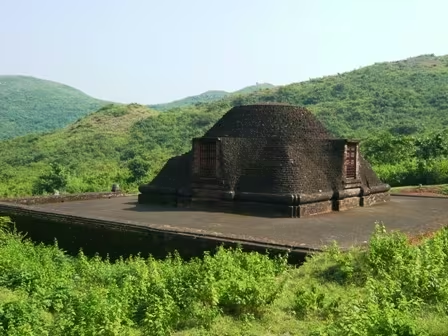
Overview
Set among the foothills of Jajpur district, Udayagiri is the largest Buddhist complex in Odisha. Its excavated remains include major stupas, monasteries, chaitya-grihas, sculptures, inscriptions, terracotta seals, residential rooms, and carefully built water and drainage features. Together with nearby Ratnagiri and Lalitgiri, it forms Odisha’s Buddhist “Diamond Triangle.”
The complex is believed to have been active between the seventh and twelfth centuries, although individual discoveries at the site have wider date ranges. Archaeological work has revealed a substantial institution rather than an isolated shrine: Udayagiri contained ritual structures, monastic buildings, domestic spaces, paved paths, drains, and platforms used for important architectural features.
Etymology and Names
Epigraphic discoveries identify Udayagiri’s historical name as Madhavapura Mahavihara. The name indicates its character as a mahavihara, or large Buddhist monastic establishment. Udayagiri was also once proposed as the location of Pushpagiri Vihara, a Buddhist centre known from ancient records. That identification is no longer accepted: the site now recognised as Pushpagiri lies elsewhere, about 18 kilometres from Udayagiri.
Geography and Location
Udayagiri lies in the foothills, approximately 90 kilometres northeast of Bhubaneswar and 70 kilometres northeast of Cuttack. The first excavated area, known as Udayagiri Site 1, occupies a depression between two valleys. Ratnagiri and Udayagiri are about 11 kilometres apart as the crow flies, while both are roughly 7 kilometres from Lalitgiri.
Its position within this cluster is central to understanding the site. Udayagiri is not a solitary monument but part of a wider Buddhist landscape containing multiple monasteries and ritual establishments.
Ancient and Medieval History
The Archaeological Survey of India began excavations at Udayagiri in 1958. Work at Site 2 between 1985–86 and 1989–90 exposed a Buddhist monastic complex enclosed by a compound wall. Its most striking feature was a stupa approximately 7 metres high. Four images of dhyani Buddhas were fixed at its four cardinal points. Epigraphic evidence from the complex led archaeologists to identify it as Madhavapura Mahavihara.
A further excavation between 1997 and 2000 revealed another part of Udayagiri-2. This area contained two eighth-century monastic complexes, along with images of Buddha, Tara, Manjusri, Avalokitesvara, and Jatamukuta Lokesvara. Numerous terracotta seals were also found. A stepped stone well carrying epigraphic inscriptions added evidence of the organised nature of the settlement.
Investigations from 2001 to 2004 uncovered additional architectural details. These included stone-finished flooring in front of a monastery, a main drain flowing northward, and a large raised stone platform measuring 14.05 by 13.35 metres. Built in seven layers of ashlar masonry, the platform was approached by steps and marked at its northern end by a chandrashila, or moon stone.
Religious and Cultural Importance
The platform supported apsidal chaitya-grihas facing east. One earlier chaitya-griha had been replaced by another built in brick. Inside was a deified stupa constructed with both stone and brick. Remains of stone jali, decorated with a three-hooked snake motif interpreted as gavakshas, or horse-shoe arches, were also found.
Several groups of stupas stood around the chaitya-griha. Their plain stone plinths survive in the western, southern, and northern areas. Four sculptures—Avalokitesvara, Tathagata, Bhrikuti-Tara, and Chunda—were embedded in niches marking the four cardinal directions.
Udayagiri has also yielded images of Kurukulla Tara, an emanation of Amitabha shown seated in lalitasana, and Hariti. Hariti appears seated while breastfeeding a child or holding one on her lap. In Buddhist tradition, she was transformed from a child abductor into a protector of children after being persuaded by the Buddha.
Monuments and Archaeology
Fourteen stupas built of brick and mud mortar have been dated between the first and twelfth centuries. Stone votive stupas line a paved path, offering evidence of individual devotional activity alongside the larger institutional structures.
At the eastern side of the chaitya-griha were residential houses containing six rooms and domestic objects. Another notable feature near an entrance is a human figure swinging from a rope with closed eyes, represented in a state of complete happiness.
Despite being only about 5 kilometres from Ratnagiri, Udayagiri has not produced artefacts establishing a connection with the Vajrayana tantric practices associated with that neighbouring site. This distinction highlights the importance of treating the three complexes as related but archaeologically distinct centres.
Modern Status and Legacy
Udayagiri remains an important archaeological site for understanding the development of Buddhist institutions in Odisha. Its inscriptions, sculpture, architecture, and domestic remains together illuminate the religious and practical life of a large monastic complex. The continuing excavations by the Archaeological Survey of India have expanded knowledge of the site from a single excavated area to a wider landscape of monasteries, stupas, ritual buildings, and residential spaces.
Timeline
Buddhist complex develops
Udayagiri is believed to have been active from around the seventh century CE.
Monastic expansion
Two eighth-century monastic complexes formed part of Udayagiri-2.
ASI excavations begin
The Archaeological Survey of India begins excavating Udayagiri.
Site 2 investigated
Excavations reveal the enclosed monastery and seven-metre stupa with four dhyani Buddhas.
Further discoveries
Additional monasteries, stupas, sculptures, seals, and an inscribed stone well are uncovered.
Architectural investigations
Excavations reveal the raised platform, chaitya-grihas, drainage, and residential remains.