
The Emperor Who Walked Through Blood: Ashoka's Transformation at Kalinga
The year was approximately 261 BCE, and the Mauryan Empire stood at the height of its power. Yet one region remained defiant, one jewel unclaimed in the crown of dominion that stretched from Afghanistan to the Deccan Plateau. Kalinga, perched on the Bay of Bengal coast, represented more than territory—it was a challenge to imperial destiny itself.
The Conquest Begins
Emperor Ashoka stood on the balcony of his palace in Pataliputra—the city we know today as Patna—watching the Ganges flow like liquid silver in the pre-dawn light. Below him, the machinery of war assembled with practiced precision. War elephants, their tusks sheathed in iron, swayed in formation. Infantry units bearing the Mauryan insignia gathered in ordered ranks, their spears creating a forest of steel that stretched beyond sight.
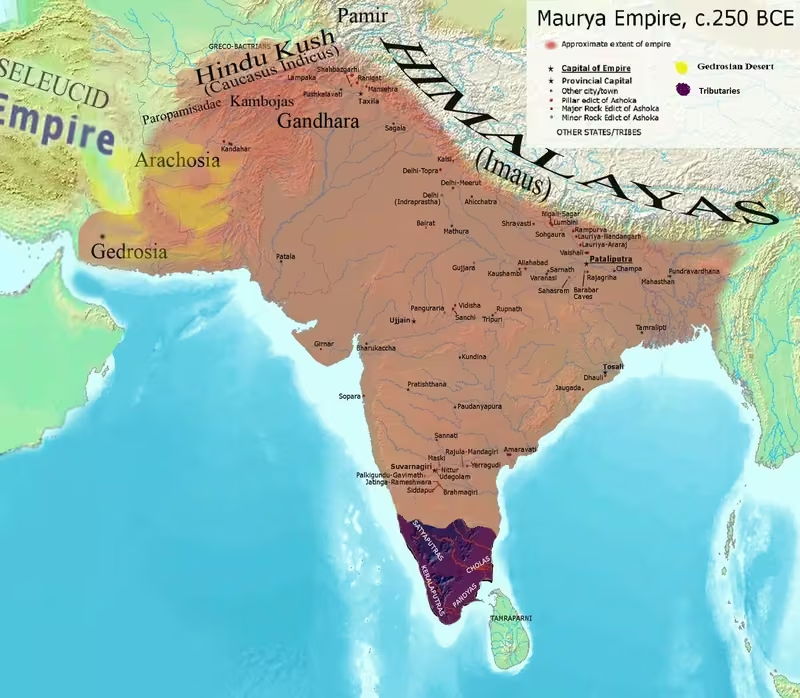
He was the grandson of Chandragupta Maurya, the founder who had forged this empire around 320 BCE by defeating the Nanda dynasty and extending Mauryan suzerainty as far west as Afghanistan, below the Hindu Kush mountains. That legacy weighed upon Ashoka like armor—protective and suffocating in equal measure.
The Mauryan Empire controlled the major urban hubs and arteries of the subcontinent, excepting only the deep south. Taxila commanded the northwest. Ujjain held the Malwa Plateau. The precious metal-rich lower Deccan Plateau fed the empire's coffers. But Kalinga remained independent, a defiant gap in the coastal network that connected these core regions.
Ashoka had inherited an empire that existed, according to later historical accounts, "in loose-knit fashion." Beyond the core areas of Magadha, the prevailing levels of technology and infrastructure limited how deeply imperial rule could penetrate society. The empire's geographical extent depended heavily on the loyalty of military commanders who controlled the armed cities scattered throughout its vast territories.
But loyalty, Ashoka knew, flowed from strength. And strength would be demonstrated at Kalinga.
As dawn broke fully over Pataliputra, the emperor descended to join his armies. The conquest of Kalinga would complete what his grandfather had begun. It would prove that the Mauryan Empire was not merely extensive but invincible.
The march eastward began.
The Battle of Kalinga
The Kalinga campaign unfolded with brutal efficiency. Ashoka's forces, numbering in the tens of thousands, swept across the coastal plain like a monsoon storm. The defenders of Kalinga fought with the desperation of those protecting their homeland, but they faced an imperial war machine refined through decades of conquest.
War elephants crashed through defensive lines, their trumpeting screams mixing with the clash of bronze and iron. The Mauryan military commanders—those loyal officers upon whom the empire's reach depended—coordinated their armed units with practiced skill. Infantry advanced in waves. Cavalry struck at flanks and supply lines. The tactics that had subdued kingdoms from the Hindu Kush to the Deccan were deployed with merciless precision.
The Bay of Bengal gleamed in the distance, indifferent to the violence unfolding on its shores. Smoke rose from burning structures. The coastal winds carried the acrid smell of destruction inland. According to the historical records that would survive in Ashoka's own edicts, his troops "visited much violence" upon the region—a phrase that barely contained the horror it described.
Kalinga had been one of the core regions of strategic importance, controlling vital maritime and river-borne trade routes. The Mauryan economy depended on such commerce for acquiring goods for consumption and metals of high economic value. The dynasty had built roads—most prominently the Uttarapath, which connected eastern Afghanistan to Pataliputra during winter when water levels in intersecting rivers were low and could be easily forded. Other roads connected the Ganges basin to the Arabian Sea coast in the west and to the southern mines.
Kalinga's ports were essential to this network. But beyond economics, beyond strategy, the conquest had become something else entirely—a demonstration of imperial will that exceeded all bounds of proportionality.
The battle raged for days. The Mauryan forces, superior in numbers and organization, ground down Kalinga's resistance. The population of South Asia during this Mauryan period was estimated between 15 and 30 million. A significant portion of Kalinga's people—soldiers and civilians alike—now stood in the path of history's crushing wheel.
When the fighting finally ceased, the silence that followed was more terrible than any battle cry.
The Blood-Soaked Aftermath
Ashoka walked alone across the battlefield as the sun descended toward the Bay of Bengal, painting the sky the color of wounds.
The accounts vary, but the most commonly cited figure speaks of 100,000 dead. One hundred thousand souls who had woken to ordinary mornings, who had loved and hoped and feared, now lay still upon the earth. The ground was dark with blood. Bodies sprawled in the grotesque poses death imposes, stripped of dignity, reduced to meat and bone.
Smoke still rose from the ruins of Kalinga's cities. The cries of the wounded and dying filled the air—a chorus of agony that no imperial triumph could silence. Ashoka's armor, splendid in the morning when he had surveyed his armies, now felt like a shell containing nothing but horror.
He had achieved his objective. Kalinga was conquered. The Mauryan Empire now controlled the Bay of Bengal coast completely. The strategic gap was closed. The trade routes were secured. By every military and political measure, this was victory.
But what kind of victory requires a man to wade through rivers of blood?
The emperor stopped at a pool of water—once clear, now crimson with the runoff of slaughter. In its surface, he saw his own reflection distorted and dark. The face that looked back at him was that of a stranger, a man who had ordered this devastation in pursuit of dominion that now seemed hollow beyond measure.
Later, in the edicts he would inscribe across South Asia, Ashoka would write of this moment with stark honesty. The Kalinga War had visited unprecedented violence upon the region. The suffering was total. The cost was incalculable.
And it was all his doing.
As darkness fell over the battlefield, something broke within the emperor. Or perhaps something finally awakened. The ideology of conquest that had driven his grandfather Chandragupta, the assumption that power justified its own expansion, the belief that empire was destiny—all of it crumbled like ash.
Ashoka had conquered Kalinga. But Kalinga had conquered something in him as well.
The Emperor's Transformation
In the months following the Kalinga War, Ashoka embraced Buddhism. The historical record, preserved in his own edicts scattered across South Asia, documents this transformation with unusual clarity for the ancient world.
Buddhism and Jainism had risen in the centuries before the Mauryan Empire, promoting nonviolence, proscribing ostentation and superfluous sacrifices and rituals. These creeds had helped the Mauryan economy by reducing the costs of economic transactions and promoting more intricate business dealings. But for Ashoka, Buddhism offered something beyond economic utility—it offered redemption.
The emperor who had walked through blood now walked a different path. He renounced violence forever. The military conquests that had defined Mauryan expansion ceased. Ashoka declared that the only true conquest was dharma-vijaya—victory through righteousness.
In monasteries across his empire, the emperor knelt before monks, seeking teachings that might cleanse the stain of Kalinga. He removed his crown—symbol of the power that had led to such suffering—and placed it on the ground. In that gesture, he acknowledged a truth that would echo through history: some victories are defeats, and some defeats are the beginning of wisdom.
The Edicts of Ashoka
Ashoka's transformation was not merely personal—it became policy inscribed in stone. Throughout his empire, he erected pillars and carved edicts into rock faces, creating what would become the primary written records of the Mauryan era.
These edicts, scattered across South Asia in clusters along the well-traveled road networks, promoted Buddhist tenets with remarkable specificity. They forbade the killing of wild animals and the destruction of forests—provisions that have led some modern environmental historians to see Ashoka as an early embodiment of ecological consciousness.
The edicts spoke of dharma—righteousness, duty, cosmic law. They urged compassion toward all living beings. They described the emperor's remorse over Kalinga in language that still resonates across millennia: the suffering of the conquered, the grief of families torn apart, the moral weight of violence.
Workers carved these messages into polished sandstone pillars topped with magnificent capitals. The most famous—the Lion Capital at Sarnath—featured four lions standing back to back, representing power transformed into protection. Below them, on the drum-shaped abacus, a 24-spoke wheel symbolized the dharma, the righteous path that Ashoka now promoted instead of conquest.
The empire that had spread through military might now spread something else: a world religion. Ashoka sponsored Buddhist missionaries to Sri Lanka, northwest India, and Central Asia. This missionary activity played a salient role in Buddhism becoming a world religion, and Ashoka himself became a figure of world history—not for his conquests, but for his renunciation of conquest.
The Buddhist Missions
From Pataliputra, Buddhist missionaries departed carrying scrolls and relics, traveling the roads the Mauryan dynasty had built for commerce and war. Now those roads served dharma. The Uttarapath, that winter road connecting eastern Afghanistan to the capital, became a path of spiritual transmission.
Ashoka blessed these missionaries with raised hand, sending them toward distant mountains and foreign lands. They carried with them not the threat of Mauryan military power but the promise of spiritual liberation. They spoke of the Four Noble Truths, of the Eightfold Path, of compassion and non-violence.
In Sri Lanka, in the kingdoms of Central Asia, in the regions beyond the Hindu Kush, Buddhism took root. The religion that had arisen in India centuries before now began its transformation into a global faith. And at the center of this expansion stood not a warrior king but a penitent emperor who had seen the cost of violence and chosen a different way.
The Mauryan Empire would not long survive Ashoka's death around 232 BCE. By 185 BCE, it had collapsed into the loose-knit fragments from which it had been forged. But the spiritual legacy Ashoka created would endure in ways his military conquests never could.
Legacy Carved in Stone and Spirit
In July 1947, as India prepared for independence, Jawaharlal Nehru proposed to the Constituent Assembly that the Lion Capital of Ashoka at Sarnath become the State Emblem of India. The 24-pointed Buddhist Wheel of Dharma on the capital's abacus, he suggested, should be the central feature of India's national flag.
The proposal was accepted in December 1947. Modern India chose to represent itself not through symbols of military might but through the emblems of an emperor who had renounced violence. The lions that once represented Ashoka's power now represent a nation's aspirations toward justice and dharma.
This choice was profound. India could have selected symbols from any period of its vast history—the military glory of other empires, the architectural magnificence of later dynasties, the revolutionary fervor of independence. Instead, it chose Ashoka's transformation: from violence to peace, from conquest to compassion, from empire to enlightenment.
The Kalinga War remains one of history's most documented moments of imperial remorse. While many rulers have expressed regret for their actions, few have transformed their entire governance philosophy as completely as Ashoka did. The blood-soaked battlefield became the birthplace of a different kind of power—the power of moral authority, of ethical governance, of dharma over dominion.
Today, the Lion Capital gleams in golden light at Sarnath, its 24-spoke wheel visible on the abacus, bridging ancient and contemporary India. Tourists and pilgrims visit the site where Ashoka's pillar still stands, reading about the emperor who walked through blood and chose a different path.
The Mauryan Empire, as Wikipedia notes, "was marked by exceptional creativity in art, architecture, inscriptions and produced texts." But perhaps its greatest creation was this: the idea that an emperor could change, that power could serve compassion, that the path of violence could be abandoned even by those who had walked it to its terrible end.
Ashoka's edicts, carved in stone across South Asia, have survived millennia. But his true monument is not made of stone—it is the enduring question he posed to every ruler who came after: What is the purpose of power? Is it conquest, or is it something greater?
The emperor who slaughtered 100,000 at Kalinga spent the rest of his life answering that question. His answer—carved in stone, spread by missionaries, embodied in the transformation of an empire—echoes still in the symbols of modern India and in the conscience of anyone who must choose between violence and compassion, between dominion and dharma.
Some say that history is written by victors. But Ashoka's history was written by a victor who learned that victory itself can be defeat, and that the greatest conquest is the conquest of one's own capacity for violence. In that sense, the blood-soaked battlefield of Kalinga became the birthplace not just of Ashoka's transformation, but of a possibility that still beckons to us across the centuries: the possibility of change, of redemption, of choosing peace when war seems inevitable.
The emperor who walked through blood walked out of it transformed. And in that transformation, he became immortal.