Overview
In approximately 1025 CE, Rajendra Chola I moved the Chola imperial capital from Thanjavur to a newly planned city in present-day Ariyalur district. He named it Gangaikonda Cholapuram, “the city of the Chola who took the Ganges,” linking the capital directly to his victories in northern and eastern India. The city remained the Chola seat of power for approximately 250 years.
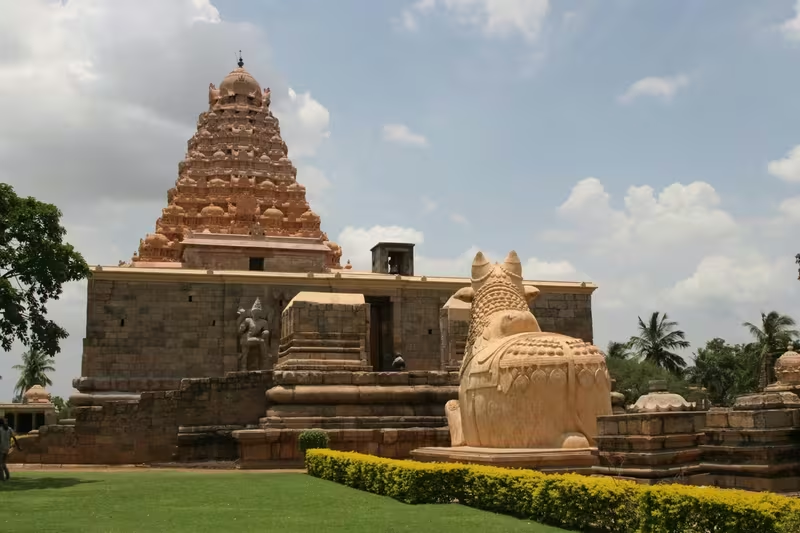
Gangaikonda Cholapuram is now a village near Jayankondam, but its surviving Brihadisvara temple preserves the ambition of the medieval capital. The temple is second in scale only to the Brihadisvara Temple at Thanjavur, built by Rajendra’s father, Rajaraja I. Around the surviving shrine, archaeological remains reveal a much larger urban landscape: fortification mounds, palace foundations, brick walls, roads, gates, irrigation channels and traces of additional temples.
The site matters because it brings together political history, sacred architecture and urban planning. It was not simply a temple settlement. It was an imperial capital designed to express Chola military success, royal authority and devotion to Shiva.
Etymology and Names
The name Gangaikonda Cholapuram is formed from several Tamil elements: Gangai, the Ganges; konda, obtained or taken; Chola, the ruling dynasty; and puram, city. Its meaning commemorates Rajendra Chola I’s northern campaign and the symbolic bringing of Ganges water to the new capital.
Chola-era tradition states that kingdoms defeated during Rajendra’s campaign sent pots of Ganges water. The water was poured into the well of the temple at the new capital. Rajendra subsequently assumed the title Gangaikonda Cholan, “the Chola who conquered the Ganges.” The city’s name therefore functioned as both a geographical designation and a statement of imperial achievement.
The site is also referred to as Gangaikondacholapuram and Gangaikondacholisvaram, the latter name especially associated with the temple dedicated to Shiva.
Geography and Location
Gangaikonda Cholapuram lies near Jayankondam in Ariyalur district, Tamil Nadu. The ancient site is designated as a heritage town within the district and is approximately 125 kilometres northeast of Tiruchirapalli International Airport.
The capital’s location was shaped by both administration and agriculture. Inscriptions refer to the Madhurantaka Vadavaru, now known simply as the Vadavaru, a channel running approximately six kilometres east of the ancient city. Named after one of Rajendra Chola I’s titles, it supplied irrigation to agricultural lands around the capital. Another channel, the Anaivettuvan, is also mentioned in inscriptions; its name refers to a dam or embankment and to the workers or engineers connected with it.
The city included wet and dry lands used for cultivation and civic purposes. Numerous small tanks, ponds and wells supplied drinking water to residents. These references show that the capital depended on an organized system of water management rather than on its monumental buildings alone.
Ancient History and Foundation
Rajendra Chola I founded Gangaikonda Cholapuram after a major military campaign across northern and eastern India. Chola-era records connect the campaign with regions including Karnataka, Andhra Pradesh, Odisha and Bengal. The city was intended to commemorate the victories, particularly the triumph over the Pala dynasty and the campaign associated with the Ganges.
The move from Thanjavur had administrative and strategic purposes. At its height, the Chola empire extended across southern India as far north as the Tungabhadra River. A new capital allowed Rajendra to establish a fresh imperial centre suited to the political needs of an expanding realm.
The city was planned according to architectural principles described in Tamil Vastu and Agama texts. The royal palace stood at the centre, with the main Shiva temple and auxiliary shrines arranged around it. The principal Shiva temple occupied the northeastern side of the palace, a location prescribed for Shiva shrines in the sacred planning traditions reflected in these texts. Vishnu temples, by contrast, were expected to stand on the western side.
Historical Timeline
Rajendra Chola I and the Imperial Capital
The surviving Brihadisvara temple was completed in 1035 CE. Rajendra modelled it on the great temple built by Rajaraja I at Thanjavur between 1003 and 1010 CE, while giving the new complex its own architectural and sculptural character.
The city contained more than the surviving shrine. Temples dedicated to Dharma Sasta, Vishnu and other deities formed part of the urban sacred landscape. Inscriptions and excavations also reveal a palace, fortifications, roads, gates and irrigation works.
Later Chola and Pandya Periods
Gangaikonda Cholapuram remained the imperial capital for roughly 250 years. During and after the later Chola period, the palace complex continued to be identified in inscriptions. An inscription from the reign of Virarajendra Chola, Rajendra’s third son, calls the palace Chola-Keralan Thirumaligai, apparently taking its name from one of Rajendra’s titles.
The city later suffered extensive destruction. Several shrines disappeared during the late thirteenth and fourteenth centuries, while the Brihadisvara temple survived. The precise cause remains uncertain. One interpretation suggests that the Pandyas may have destroyed the city after defeating the Cholas, perhaps in retaliation for earlier defeats. Another explanation connects the damage with raids by armies of the Delhi Sultanate.
The evidence does not settle the question. The survival of the main temple, together with approximately twenty later inscriptions recording grants by Chola, Pandya and Vijayanagara rulers, complicates the idea of complete and uniform destruction.
Delhi Sultanate, Madurai Sultanate and Vijayanagara Rule
Armies led by Malik Kafur in 1311, Khusrau Khan in 1314 and Muhammad bin Tughlaq in 1327 invaded Chola territory and Madurai. The following decades saw conflict between regional Hindu rulers and the Madurai Sultanate, which existed from 1335 to 1378 after separating from the Delhi Sultanate.
The Vijayanagara Empire conquered the Madurai Sultanate in 1378. This change brought the region back under Hindu rule and contributed to the restoration of several Chola-era temples. At Gangaikonda Cholapuram, the principal temple continued to receive attention, even as the wider city remained largely in ruins.
Political Significance
The city was created as a declaration of Chola power. Its name celebrated conquest, its scale reflected imperial wealth, and its planned arrangement placed the palace at the centre of political and sacred space.
Inscriptions preserve the names of royal buildings and structural divisions within the palace. They refer to the adibhumi, or ground floor, the Kilaisopana, an eastern portico, and a royal seat called Mavali vanadhirajan. These terms suggest that the palace was a multi-storeyed structure. A later inscription from the forty-ninth regnal year of Kulothunga I refers to Gangaikondacholamaligai, implying that the complex may have contained more than one royal building, each with its own name.
The capital’s fortifications also indicate its political and strategic importance. It originally had two concentric enclosures: an inner wall and a wider outer wall. Their remains survive chiefly as mounds around the palace area.
Religious and Cultural Importance
The Brihadisvara temple, dedicated to Shiva, is the centrepiece of Gangaikonda Cholapuram. Its main Shiva lingam was carved from a single block of stone. The complex also contains the Saurapitha, a lotus-shaped solar altar associated with eight deities.
The temple’s sculptures are recognized for their artistic quality and distinctive details. Chola metalwork is represented by bronze figures of Bhogasakti and Subrahmanya. The Chola period also produced numerous bronzes of Nataraja, Shiva in his dancing form, celebrated for expressive posture and detailed craftsmanship.
The temple was reconsecrated in 2017 after the installation of a dhvajastambha, or flagstaff, and the performance of the maha kumbhabhishekam ritual. Its continued ritual life adds a modern dimension to the historical monument.
Economic Role and Urban Infrastructure
The ancient capital required systems capable of supporting a royal court, religious institutions, artisans and residents. Irrigated agricultural lands around the city supplied part of this foundation. Channels, tanks, ponds and wells formed an interconnected water infrastructure.
The nearby settlement of Ayudhakalam is believed to have housed an armory and workshops for manufacturing weapons. Excavations there were conducted by the Tamil Nadu State Department of Archaeology. The possibility of such a specialized quarter reflects the city’s military and administrative character.
Inscriptions preserve the names of roads and gates, offering an outline of the city’s movement network. Entryways included the Thiruvasal, or eastern gate, and the Vembugudi gate, the southern entrance leading toward the neighbouring village of Vembugudi. Major highways included the Rajarajan Peruvali and Rajendran Peruvali, named after Rajendra and his father Rajaraja. Other recorded streets include the Pattu teru, or “ten streets,” the Thiruvasal Narasam gateway lane and the Suddhamali lane.
Monuments and Architecture
The main temple was built from stone, while the palace was constructed from burnt bricks. Palace ceilings used courses of small, flat tiles set in fine lime mortar. The pillars were probably made of polished wood resting on granite bases; a few of those bases survive. Excavations have also found iron nails and clamps.
A subterranean passage connected the palace with the northern part of the temple’s first inner enclosure, or prakaara. This physical link between palace and temple illustrates the close relationship between royal authority and sacred space in the city’s plan.
The wider urban remains include brick fortifications, soil-covered mounds, excavated pillar stumps and fragments of brick walls extending for several kilometres around the surviving temple. Most other shrines were destroyed during the late thirteenth and fourteenth centuries, leaving the Brihadisvara temple as the principal surviving monument of the capital.
Decline and Revival
The ancient city declined after the Cholas lost power, and much of its built environment disappeared. The reasons for the destruction remain debated. Pandya retaliation and Delhi Sultanate raids are both possibilities, but neither explanation accounts fully for every feature of the archaeological and inscriptional record.
The survival of the main temple was crucial. Later rulers, including Pandyas and Vijayanagara kings, recorded grants to it. After Vijayanagara defeated the Madurai Sultanate in 1378, several Chola-era temples in the region were restored. Gangaikonda Cholapuram thus remained an active religious site even after its role as an imperial capital ended.
Modern Status
Today, Gangaikonda Cholapuram is a small village whose historical importance is represented above all by the Brihadisvara temple. The ancient capital is recognized as a heritage town in Ariyalur district, and the temple forms part of the UNESCO World Heritage legacy of Chola architecture.
Visitors encounter a monument that stands amid the remains of a much larger city. The fortification mounds, palace traces, inscriptions, irrigation references and surviving sculptural works allow the site to be understood not merely as an isolated temple, but as the centre of a carefully planned imperial capital.
Timeline
Capital founded
Rajendra Chola I established Gangaikonda Cholapuram as the Chola capital after his northern and eastern campaigns.
Brihadisvara temple completed
The surviving Shiva temple was completed as the monumental centre of the new capital.
End of the long capital era
After approximately 250 years, Gangaikonda Cholapuram ceased to function as the Chola imperial seat.
Delhi Sultanate raid
An army led by Malik Kafur invaded Chola territory during a period of regional conflict.
Vijayanagara conquest
The Vijayanagara Empire conquered the Madurai Sultanate, contributing to the restoration of Chola-era temples.
Temple reconsecrated
The temple underwent reconsecration after installation of a flagstaff and performance of the maha kumbhabhishekam ritual.