Overview
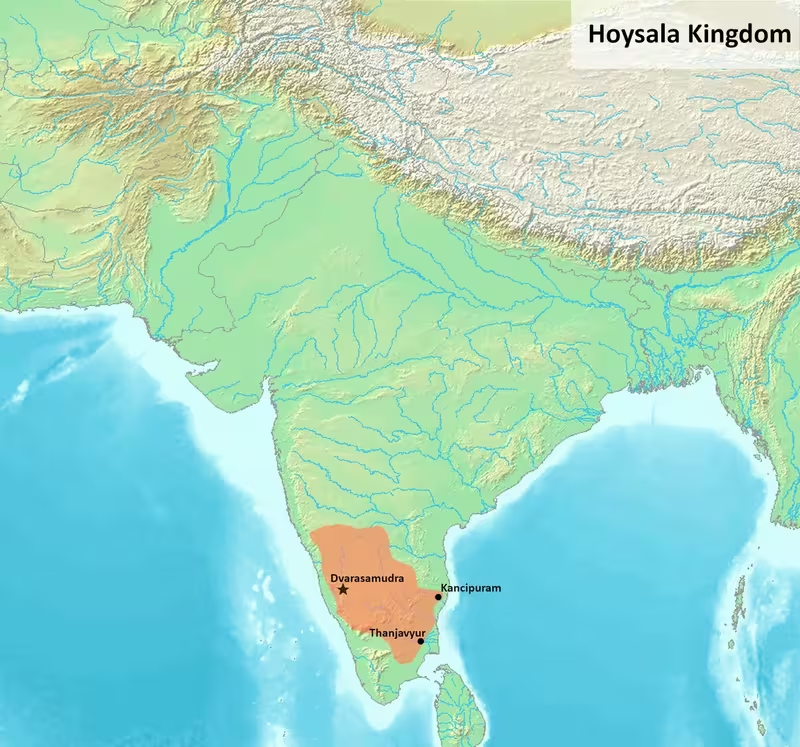
In 1116, the Hoysala ruler Vishnuvardhana defeated the Cholas at Talakadu, a victory that transformed a regional power from the Malnad into a major force of the Deccan. The Hoysalas had begun as feudatories of the Western Chalukyas of Kalyani, but during the conflicts among the Chalukyas, Cholas, Kalachuris, Pandyas, Seunas, and Kakatiyas, they steadily enlarged their authority. By the 13th century, their kingdom covered much of present-day Karnataka and extended into parts of Tamil Nadu and southwestern Telangana.
The dynasty’s capitals reflected this expansion. Its earliest capital was Sosevur, identified with present-day Angadi in Chikkamagaluru district. The court later moved to Belur and then to Dwarasamudra, the city now known as Halebidu. These centers were not only political headquarters. They were also places of temple construction, religious learning, commerce, craft production, and literary activity.
The Hoysalas are particularly remembered for their architecture. More than 100 temples associated with the period survive. Their buildings are recognized for stellate plans, richly decorated outer walls, carefully carved friezes, and sculpture made from soapstone, a material that permitted a high degree of detail. The Chennakeshava Temple at Belur, the Hoysaleswara Temple at Halebidu, and the Chennakesava Temple at Somanathapura were inscribed as UNESCO World Heritage Sites in 2023.
Hoysala society was religiously plural. Jainism received strong support in the early period, while later rulers also patronized Vaishnavism and Shaivism. Royal women, ministers, generals, merchants, temple communities, poets, mathematicians, and sculptors all contributed to the cultural world of the kingdom. Its political existence ended in the 14th century, but its inscriptions, temples, literary works, and urban traditions continue to shape the history of Karnataka.
Rise to Power
Origins in the Malnad
The earliest record of the Hoysala family dates to about 950 CE and names Arekalla as a local chieftain. He was followed by Maruga, Nripa Kama I, who is associated with approximately 976 CE, and Munda, who ruled between 1006 and 1026. Nripa Kama I carried the title Permanadi, suggesting an early alliance with the Western Ganga dynasty.
The family emerged from the Malnad, the hilly and forested region of the Western Ghats in southern Karnataka. Hoysala inscriptions refer to their early rulers as Maleparolganda, meaning “Lord of the hills.” This title connects the dynasty to the Malenadu region and reflects the political importance of its original highland base.
The Hoysalas initially served as feudatories of the Western Chalukyas of Kalyani. This position gave them access to the wider political struggles of the Deccan while also limiting their independence. Their opportunity came from the conflict between the Western Chalukyas and the Cholas. As the balance of power shifted, Hoysala chiefs extended their control beyond the Malnad and became increasingly important military actors.
The dynasty’s early history is also associated with a well-known foundation legend. Kannada folklore tells of a young man named Sala, also called Poysala, who saved his Jain teacher Sudatta by killing a tiger—or, in some versions, a lion—in a forest near Sosevur. In Old Kannada, the word for “strike” is hoy, and the story explains the name Hoy-sala.
The legend appears in an inscription at Belur associated with Vishnuvardhana and dated to approximately 1117. Yet the story contains inconsistencies, and it is best understood as folklore rather than a verified account of the dynasty’s origin. The Hoysala emblem shows Sala fighting a tiger. Since the tiger was also the emblem of the Cholas, the story may have gained popularity after Vishnuvardhana’s victory at Talakadu. In this interpretation, the emblem and legend expressed political triumph as much as genealogy.
Early inscriptions dated 1078 and 1090 describe the Hoysalas as belonging to the Yadava vamsha, or clan. These references do not directly establish a connection with the Yadavas of North India. They indicate how the dynasty presented its lineage, but the surviving early records do not provide a direct genealogical link to the northern Yadavas.
The move from local chiefs to kings
The first Hoysala rulers controlled a relatively limited area in the Malnad. Their rise depended on several factors: their position in the Western Ghats, alliances with older regional powers, military participation in the Chalukya–Chola conflict, and their ability to incorporate newly conquered areas into an expanding agrarian and administrative system.
The dynasty’s authority became more visible under Vishnuvardhana, who ruled approximately from 1108 to 1152. His reign marked a decisive stage in the transformation of Hoysala power. He fought both the Cholas and the Western Chalukyas and used military success to assert a more independent political position.
The most celebrated campaign of his reign was the defeat of the Cholas at Talakadu around 1116. Chola incursions into Gangavadi had reportedly included the destruction of Jain basadis around Talakadu. Vishnuvardhana’s general Ganggaraj led the Hoysala counter-offensive and defeated the Chola general Adiyamma near Talakadu. The Hoysalas recovered the lost territory, and Vishnuvardhana took the title Talakadugonda, “Conqueror of Talakadu.”
Hoysala inscriptions emphasize Ganggaraj’s role in the victory. The campaign therefore illustrates the importance of military commanders as well as kings in the expansion of the kingdom. Ganggaraj later continued his support of Jain institutions, showing how military service, political authority, and religious patronage could be connected in Hoysala society.
Vishnuvardhana also fought the Western Chalukyas in Nolambavadi. These campaigns expressed his growing independence from the power to which the Hoysalas had once been subordinate. In a later campaign against the Cholas, Hoysala forces pursued the Chola army as far as Vellore in Tamil territory. Land grants made to Ganggaraj at Kambadahalli after these victories helped establish that place as an important Jain center.
The military successes of Vishnuvardhana weakened Chola influence in the Deccan and gave the Hoysalas control over territories that could support further expansion. Historians have therefore treated his reign as pivotal in the establishment of Hoysala independence.
Golden Age
Expansion under Veera Ballala II
Vishnuvardhana’s grandson Veera Ballala II strengthened the kingdom further. He declared war against the Yadavas and defeated the Kadambas. In 1193, he declared independence, confirming the political change that had developed over the preceding generations.
The Deccan Plateau at this time was divided among several competing powers. The Hoysalas, Pandyas, Kakatiyas, and Seunas all sought regional hegemony, while the Cholas remained important in the Tamil country. Hoysala expansion was consequently not a single uninterrupted conquest. It involved wars, alliances, restoration of rulers, and struggles over strategic territories.
In 1217, Veera Ballala II defeated an aggressive Pandya force that had invaded the Chola Kingdom. He helped restore the Chola ruler to the throne and assumed the title Dakshina Chakravarthi, “Emperor of the south.” The title expressed the scale of his ambitions, although Hoysala power continued to depend on military competition with neighboring kingdoms.
The dynasty extended its influence farther south during the first half of the 13th century. Around 1225, it established a foothold in present-day Tamil Nadu. Kannanur Kuppam, near Srirangam, became a provincial capital and a base for Hoysala authority in the southern Deccan and Tamil country.
Vira Narasimha II, the son of Veera Ballala II, continued the southern policy. His son Vira Someshwara received the honorific Mamadi, meaning “uncle,” from both the Pandyas and the Cholas. Between approximately 1220 and 1245, Hoysala hegemony reached southward over areas associated with both kingdoms.
By the late 13th century, Veera Ballala III recovered territory in the Tamil country that had been lost during a Pandya uprising. This temporarily reunited the northern and southern portions of the Hoysala Kingdom. At its greatest reach, Hoysala political influence extended across much of Karnataka and into northwestern Tamil Nadu and western Andhra Pradesh, now Telangana.
The capitals of the kingdom
The movement of the capital provides a useful way to understand the changing priorities of the dynasty.
Sosevur, also called Sasakapura or Sosavurpattana, was located at present-day Angadi in Chikkamagaluru district. It was regarded as the original home of the Hoysala family and was a prominent Jain religious center. Sosevur served as the capital from approximately 1026 to 1048. Even after the court moved elsewhere, it remained an important commercial, administrative, and Jain center.
In 1048, the capital shifted to Belur. The city was attractive for several reasons. It stood on the Yagachi River, giving it a dependable water supply. Its hilly setting offered defensive advantages, and it lay along a trade route useful for commerce and communication. Belur remained the capital for only about a decade, but its importance increased considerably under Vishnuvardhana, especially through the construction of the Chennakeshava Temple.
In 1062, the capital moved again, this time to Dwarasamudra, also known as Dorasamudra or Dvaravatipur. The site is now called Halebid, or Halebidu. Dwarasamudra remained the principal Hoysala capital until the end of the dynasty. The reason for the move is not known with certainty, although administrative convenience may have played a role.
Canals connected Dwarasamudra with Belur and brought water from the Yagachi. Two trade routes passed through the city, and numerous temples were constructed there. Dwarasamudra was therefore a political center, an urban settlement, a religious landscape, and a commercial hub. Its decline in the 14th century was connected to the wider political crisis that affected the kingdom.
Administration and Governance
The Hoysala state used many administrative methods that had already developed under earlier South Indian powers, while adapting them to its own territorial expansion. The king stood at the center of government, but authority was exercised through ministers, military commanders, provincial officials, landlords, village officers, and subordinate ruling families.
Senior ministers were known as Pancha Pradhanas. Officials responsible for foreign affairs were called Sandhivigrahi. The chief treasurer was the Mahabhandari or Hiranyabhandari. Dandanayakas commanded armies, while the Dharmadhikari served as chief justice of the royal court.
The kingdom was divided into territorial units known as Nadu, Vishaya, Kampana, and Desha, listed from larger to smaller divisions in the administrative hierarchy described in the records. Each province had a local governing body. A Mahapradhana served as a minister, and a Bhandari acted as treasurer. These officials reported to the ruler of the province, who was identified as a Dandanayaka.
Below the provincial authorities were Heggaddes and Gavundas. They hired and supervised farmers and laborers who cultivated land and worked in forests. The Gavunda was an important rural figure. A praja gavunda, or “Gavunda of the people,” held a lower status than a wealthier prabhu gavunda, “Gavunda of the lord.” These distinctions show that village society included substantial differences in rank and property.
Subordinate ruling clans, including the Alupas, continued to govern their own territories while following imperial policies. This arrangement allowed the Hoysala state to incorporate different regions without replacing every local authority. The kingdom therefore combined royal direction with provincial and local administration.
Royal protection and military service
The royal household was protected by an elite bodyguard force known as the Garudas. These highly trained guards remained close to members of the royal family and were expected to display exceptional loyalty. According to the historical tradition recorded in connection with them, Garudas committed suicide after the death of their master.
Garuda pillars, or hero stones, commemorated these bodyguards. A Garuda pillar at the Hoysaleswara Temple in Halebidu honors Kuvara Lakshma, a minister and bodyguard of Veera Ballala II. Such monuments linked personal loyalty, military service, royal honor, and public memory.
Hoysala military power depended on commanders such as Ganggaraj, who played a leading role in the campaigns against the Cholas. The state also relied on imported horses for transportation and cavalry. The western seaboard supported a flourishing horse trade, reflecting the connection between maritime commerce and military organization.
Land, taxation, and irrigation
The Hoysala economy rested heavily on agriculture. The kingdom included the valleys of the Krishna, Tungabhadra, and Kaveri rivers, whose water systems supported extensive cultivation. The Malnad highlands, with their temperate climate, were suited to cattle raising, orchards, and spices. Paddy and millets were staple crops of the tropical plains, known as Bailnad.
As cultivated land became scarce, forests, wastelands, and previously unfarmed areas were brought under cultivation. New settlements were established, and forests were cleared for fields and villages. Hoysala kings rewarded service with land grants. The heads of families who received such grants could become landlords and Gavundas, with tenants working the land and forests.
Land was assessed according to whether it was wet land, dry land, or garden land. Taxation also considered soil quality. Village records mention taxes on commodities such as gold, precious stones, perfumes, sandalwood, ropes, yarn, houses, hearths, shops, cattle enclosures, and sugarcane presses. Produce subject to taxation included black pepper, betel leaves, ghee, paddy, spices, palm leaves, coconuts, and sugar.
Irrigation was a central concern. The state financed the construction of tanks, or large reservoirs, and supported the repair of breached embankments and damaged sluices after heavy rains. Canals and wells were also built and maintained. Taxes were collected on irrigation systems, but local villagers and landlords carried out many repairs. Maintaining these works was treated not only as an economic responsibility but also as a duty and a pious act.
The administrative system thus depended on cooperation between the court, provincial officers, landlords, and villages. Agricultural expansion produced revenue, while irrigation enabled communities to survive and prosper in a varied environment.
Military Campaigns
The struggle with the Cholas
The Chola conflict was central to the formation of Hoysala power. Chola incursions into Gangavadi challenged Hoysala control and reportedly damaged Jain basadis around Talakadu. Vishnuvardhana responded through a counter-offensive led by Ganggaraj.
The Hoysala victory at Talakadu around 1116 had several consequences. It recovered territory, weakened Chola influence in the Deccan, enhanced Vishnuvardhana’s prestige, and provided the political setting for the title Talakadugonda. The Hoysala emblem’s tiger-fighting figure may also have gained wider recognition after this victory because the tiger represented the Cholas.
The Hoysalas later carried the war into Tamil territory. Their army pursued Chola forces to Vellore, far inside the Tamil country. Although the dynasty’s expansion did not eliminate Chola power immediately, these campaigns changed the political balance and helped make the Hoysalas a major southern kingdom.
Independence from the Chalukyas
The Hoysalas also fought the Western Chalukyas in Nolambavadi. These campaigns were part of the dynasty’s effort to escape its earlier position as a Chalukya feudatory. As Chalukya power declined, the Hoysalas gained room to act independently.
The process was gradual rather than a single declaration of separation. Military victories, territorial administration, land grants, royal titles, and the movement of the capital all contributed to the creation of an independent kingdom. Veera Ballala II’s declaration of independence in 1193 formalized this development.
Conflict with the Pandyas and other Deccan powers
Hoysala expansion brought the dynasty into conflict with the Pandyas in the south and the Seunas in the north. Kakatiya power also formed part of the competitive political landscape of the Deccan. The four-way struggle among the Hoysalas, Pandyas, Kakatiyas, and Seunas made the 12th and 13th centuries a period of shifting alliances and military pressure.
Veera Ballala II’s victory over the Pandya invasion in 1217 allowed him to restore the Chola ruler and claim the title Dakshina Chakravarthi. Later Hoysala rulers extended their influence through the Tamil country, but Pandya resistance remained a major challenge. Veera Ballala III eventually recovered territories lost during a Pandya uprising, temporarily joining the northern and southern parts of the Hoysala realm.
Invasions from the north and the final resistance
The political order of the Deccan changed sharply in the early 14th century. The Delhi Sultanate sought to control southern India. In 1311, Alauddin Khalji sent Malik Kafur to plunder Devagiri, the capital of the Seuna Kingdom. By 1318, the Seuna Kingdom had been subjugated.
The Hoysala capital Halebidu was besieged and sacked in 1311 and again in 1327. By 1336, the Sultan had conquered the Pandyas of Madurai, the Kakatiyas of Warangal, and the small Kingdom of Kampili. The Hoysalas became the last major Hindu kingdom in the region to continue resisting the invading armies.
Veera Ballala III based himself at Tiruvannamalai, from where he resisted forces from the north and the Madurai Sultanate to the south. His resistance lasted for nearly three decades, but the pressure eventually became overwhelming. He was killed at the battle of Madurai in 1343.
After his death, the sovereign territories of the Hoysala Kingdom were merged with areas administered by Harihara I in the Tungabhadra region. This new Hindu kingdom resisted northern invasions and later developed into the Vijayanagara Empire.
Cultural Contributions
Religion and patronage
The religious history of the Hoysalas was marked by patronage rather than exclusive commitment to a single tradition. The early rulers were strong supporters of Jainism. Hoysala kings and ministers funded Jain institutions, temples, basadis, and scholars.
Vishnuvardhana began his reign as a Jain when he was known as Bitti Deva. He continued to support Jain institutions before later converting to Vaishnavism under the influence of the philosopher Ramanujacharya. His conversion did not end royal support for Jainism. His queen Shantala Devi and members of the royal family remained Jain devotees.
Shantala Devi spent her later years at Shravanabelagola. After the death of her son, she took the Jain vow of Sallekhana, a ritual fast leading to death, at Shivagange in 1131. An inscription from 1131 at Chandragiri Hill in Shravanabelagola records her death in the presence of her teacher Prabhachandra Siddhanta Deva, Vishnuvardhana, and her mother Machikabbe. The inscription praises her piety, records her lineage, and mentions grants to Jain temples.
Ganggaraj, Vishnuvardhana’s general, also supported Jain institutions. After his military career, he is recorded as having retired to Shravanabelagola. His grants helped expand Jain religious infrastructure at Shravanabelagola and Kambadahalli.
Later rulers increasingly supported Vaishnavism. Narasimha I and Veera Ballala II patronized important Hindu temples and monasteries. Yet the royal family continued to support Jainism. An inscription records that Narasimha III worshipped Parshvanatha, the twenty-third Jain Tirthankara, and that his spiritual adviser was Meghanandi Siddhanta, a Digambara Jain monk.
Shaivism also flourished. Jain, Brahmin, Shaiva, and Vaishnava poets and scholars received patronage, while temples and religious centers were established across the kingdom. The decline of Hoysala political power was followed by a gradual decline of Jain influence in the Karnataka region, but the monuments and inscriptions of the period preserve evidence of its earlier importance.
Architecture and sculpture
Hoysala architecture developed from the Western Chalukya tradition while incorporating strong Dravidian influences. It is often described as Karnata Dravida, a distinctive architectural tradition with features that set it apart from other forms of South Indian temple architecture.
The style favors intricate detail and refined craftsmanship over massive height. Towers above the sanctum, or vimanas, were delicately finished with carved decoration. The base of the shrine often used a stellate, or star-shaped, plan made of rhythmic projections and recesses. This pattern continued upward through decorated tiers.
Soapstone, also called chloritic schist, was the principal building and sculptural material. Because it was relatively soft when worked, artisans could create complex figures, ornaments, and narrative scenes. The sculpture is especially noted for its attention to feminine beauty, graceful movement, elaborate dress, and finely rendered physical form.
Temple exteriors commonly contain horizontal friezes and rows of stone sculpture. Scenes from Hindu epics are arranged according to the traditional clockwise direction of circumambulation. The result is an architectural surface in which structure, religious narrative, ornament, and movement are closely integrated.
The Chennakeshava Temple at Belur was built in 1117. The Hoysaleswara Temple at Halebidu dates to 1121. The Chennakesava Temple at Somanathapura was constructed in 1279. Other important Hoysala temples stand at Arasikere, Amruthapura, Belavadi, Nuggehalli, Hosaholalu, Aralaguppe, Korvangla, Haranhalli, Mosale, and Basaralu.
Although Belur and Halebidu are the best-known examples, smaller temples often show the Hoysala style in a particularly complete form. Their detailed sculptures and carefully organized decorative programs demonstrate that architectural innovation was not confined to the royal capitals.
The temples of Belur, Halebidu, and Somanathapura were designated UNESCO World Heritage Sites in 2023. Their recognition reflects the enduring importance of Hoysala craftsmanship in the history of Indian architecture.
Literature and learning
The Hoysala period was a major era of literary production in Kannada. Jain, Shaiva, and Vaishnava Brahmin writers contributed to the language, while Sanskrit remained important for poetry, grammar, lexicons, manuals, rhetoric, commentaries, prose fiction, and drama.
Janna, the court poet of Veera Ballala II, wrote Yashodhara Charite, a classic of Kannada literature. Keshiraja, a Kannada grammarian, wrote Shabdamanidarpana. These works demonstrate the development of both creative writing and grammatical scholarship.
Jain centers at Shravanabelagola and Kambadahalli served as places of learning, including instruction in astronomy and mathematics. The Jain mathematician Rajaditya wrote works on arithmetic and geometry, including Vyavaharaganita. Mahaviracharya’s Ganitasarasangraha became a standard mathematical text. Inscriptions record Jain saints maintaining centers for astronomical and mathematical studies under Hoysala patronage.
The period was especially important for Kannada Jain literature. The historian R. Narasimhacharya observed that more Jains wrote in Kannada during this period than in any other Dravidian language. Jain works often praised the Tirthankaras and preserved ethical and religious themes.
Kannada poetic forms also developed. The Sangatya metre became popular, while the Shatpadi, Tripadi, and Ragale forms allowed greater variety in verse. Shatpadi means a six-line form, Tripadi a three-line form, and Ragale refers to lyrical blank verse.
Brahminical writers made important contributions as well. Rudrabhatta, patronized by Chandramouli, a minister of Veera Ballala II, wrote Jagannatha Vijaya in the Champu style. The work narrates the life of Krishna up to his battle with Banasura and draws on the Vishnu Purana and related traditions.
Harihara, also known as Harisvara, was patronized by Narasimha I. He wrote Girijakalyana in the Champu style, recounting the marriage of Shiva and Parvati in ten sections. A native of Halebidu from a family of accountants, Harihara also composed more than one hundred Ragales praising Virupaksha, a form of Shiva.
Raghavanka introduced the Shatpadi metre into Kannada literature through Harishchandra Kavya. The work is regarded as a classic, even though it sometimes departs from strict grammatical rules.
Kannada and Sanskrit
The Hoysala rulers strongly supported Kannada. Inscriptions were frequently written in polished, poetic Kannada and sometimes included decorative floral designs in their margins. According to the historian Sheldon Pollock, the Hoysala period saw the near-complete displacement of Sanskrit by Kannada as the primary courtly and administrative language.
This change did not mean that Sanskrit disappeared. Sanskrit continued to serve important literary, scholarly, religious, and ceremonial purposes. Inscriptions often used Sanskrit for royal titles, genealogies, origin myths, and blessings. Kannada was commonly used for practical details of grants, including land boundaries, local authorities, rights, obligations, taxes, and witnesses. This arrangement made official records understandable to local communities while preserving Sanskrit’s prestige in formal portions of the inscription.
Jain and Buddhist monasteries educated novice monks, while higher learning took place in institutions known as ghatikas. Temples also served as local schools, where Brahmins taught Sanskrit. At the same time, Kannada was central to devotional movements emphasizing a direct and intimate experience of the divine.
Economy and Trade
The Hoysala economy was primarily agrarian but closely connected to commerce, urban centers, temple institutions, and overseas exchange. The river valleys of the Krishna, Tungabhadra, and Kaveri supported extensive agriculture. The Malnad highlands provided cattle, orchards, and spices, while the tropical plains produced paddy and millets.
The state promoted the development of new settlements through land grants and tax concessions. These measures encouraged people to move into newly cultivated areas. Forest clearance, irrigation construction, and the formation of villages increased the productive capacity of the kingdom.
Revenue from trade and commerce was collected in cash. This wealth allowed the state to purchase armaments, elephants, horses, and luxury goods. The prosperity of the royal government was therefore linked to the activity of merchants and market towns.
Some wealthy merchants were known as Rajasresthigal, or “royal merchants.” They received official recognition because of their wealth and were described as puramulasthamba, “the pillars of the towns.” Other merchants became Pattanaswamis, or town administrators, with authority to collect tolls on goods entering the town.
Merchants also participated in minting. Some produced coins and supplied them to the state. Hoysala coins included the Honnu or Gadyana, a gold coin weighing 62 grains. The Pana or Hana was one-tenth of a Honnu; the Haga was one-fourth of a Pana, and the Visa was one-fourth of a Haga. Other denominations included the Bele and Kani.
Markets and weekly fairs formed the basis of urban commerce. Towns were known as Pattana or Pattanam, while marketplaces could be identified as Nagara or Nagaram. Shravanabelagola illustrates this development. It began as a religious settlement in the 7th century but became an important trading center by the 12th century, when wealthy merchants arrived.
Belur expanded into a royal city after Vishnuvardhana sponsored the Chennakeshava Temple. Halebidu, meanwhile, grew around the capital, trade routes, waterworks, and extensive temple construction. Temples employed sculptors, artisans, priests, administrators, and other workers, giving them an important economic role in addition to their religious functions.
The western coast connected South India to overseas networks. Horses were imported for use in transportation and cavalry. Song dynasty records from China mention Indian merchants in ports of South China. South Indian exports included textiles, spices, medicinal plants, precious stones, pottery, salt, jewels, gold, ivory, rhinoceros horn, ebony, aloe wood, perfumes, sandalwood, camphor, and condiments.
These goods reached China, Dhofar, Aden, and Siraf, a port connected to Egypt, Arabia, and Persia. Trade on the western coast also brought Arabs, Jews, Persians, Europeans, Chinese, and people from the Malay Peninsula into contact with South India. Such connections introduced new cultures, skills, and commercial relationships.
Temple construction was frequently supported by merchants and landlords. These patrons were not only expressing religious devotion. They were also strengthening local economies, establishing prestige, supporting craft communities, and participating in the fiscal and political organization of agrarian society.
Society and Urban Life
Hoysala society was hierarchical, agrarian, religiously diverse, and increasingly urbanized. Villages were the basic units of administration and production. Land grants to temples, monasteries, and scholars supported religious institutions and local elites.
Caste divisions were significant. Brahmins received patronage for education and ritual services, while agriculturists, artisans, merchants, and laborers performed other essential economic roles. At the same time, inscriptions reveal forms of social mobility through military service, state employment, and religious endowments.
Urban centers such as Halebidu, Belur, Shravanabelagola, and Somanathapura became centers of trade, craft production, and temple building. Merchant guilds, artisans, and sculptors contributed to the distinctive visual culture of the period.
Large temples served several functions. They were places of worship, centers of employment, settings for education, and institutions involved in social and judicial affairs. Their construction brought together kings, ministers, merchants, landlords, sculptors, priests, and administrators. Temple-centered urbanism therefore connected religious patronage with economic and social organization.
The position of women varied according to status, occupation, and institutional setting. Records describe Queen Umadevi managing Halebidu during the military campaigns of Veera Ballala II. She is also credited with suppressing rebellious feudatories. Queen Shantala Devi was renowned for her skill in dance and music and remained a devout Jain.
Temple dancers, or Devadasis, were common and were often well educated and accomplished in the arts. Their training gave them comparatively greater freedom than many other women, although the wider social order remained hierarchical. After the 12th century, Vachana Sahitya poets and Lingayat mystics such as Akka Mahadevi also contributed to the bhakti movement.
The coexistence of Jainism, Shaivism, Vaishnavism, and local traditions gave Hoysala society a plural character. This pluralism did not remove social inequality, but it created a cultural environment in which different religious communities could establish temples, schools, monasteries, and literary traditions.
Decline and Fall
The Hoysala Kingdom reached its greatest political influence during the 13th century, but its position remained vulnerable. The dynasty faced pressure from the Pandyas to the south, the Seunas to the north, and the Kakatiyas and other regional powers. Maintaining authority across Karnataka, the Tamil country, and parts of the western Deccan required continuous military intervention.
The larger political crisis of the early 14th century proved decisive. The Delhi Sultanate extended its campaigns into the Deccan and southern India. The Seuna Kingdom was subjugated by 1318. The Kakatiyas of Warangal, the Pandyas of Madurai, and the Kingdom of Kampili were also conquered by 1336.
Halebidu was besieged and sacked in 1311 and 1327. These attacks damaged the political center of the kingdom and demonstrated the growing power of the northern armies. The Hoysalas continued to resist even after neighboring states had fallen.
Veera Ballala III established himself at Tiruvannamalai and fought both the northern invaders and the Madurai Sultanate. His resistance continued for almost three decades. The final phase of Hoysala history was therefore not an immediate collapse but a prolonged struggle under increasingly difficult conditions.
Veera Ballala III was killed at the battle of Madurai in 1343. After his death, the sovereign territories of the kingdom were merged with areas administered by Harihara I in the Tungabhadra region. That new political formation resisted northern invasions and later prospered as the Vijayanagara Empire.
Legacy
The Hoysala legacy is visible most clearly in the temples of Karnataka. Belur, Halebidu, and Somanathapura preserve the dynasty’s distinctive approach to architectural detail, sculptural narrative, and the use of soapstone. Their surfaces combine mythology, ornament, figures, friezes, and architectural rhythm in ways that remain central to the study of South Indian art.
The dynasty also left a substantial literary legacy. Kannada developed as a major courtly and administrative language, while Jain, Shaiva, and Vaishnava writers created influential works in poetry, grammar, mathematics, religion, and drama. Sanskrit continued to support scholarly and religious production, but Kannada became increasingly prominent in official and literary life.
Hoysala inscriptions provide evidence for land grants, taxation, irrigation, local government, military service, religious patronage, and social organization. They record not only the deeds of rulers but also the activities of queens, generals, merchants, priests, village officials, and religious teachers.
The kingdom’s history also illustrates the political complexity of medieval South India. The Hoysalas began as feudatories, gained independence amid Chalukya and Chola rivalry, expanded into the Tamil country, and competed with the Pandyas, Kakatiyas, and Seunas. Their fall occurred within a wider transformation caused by the expansion of the Delhi Sultanate and the emergence of Vijayanagara.
Their temples continued to shape regional identity long after Hoysala political authority disappeared. The UNESCO inscription of the Belur, Halebidu, and Somanathapura temples in 2023 has drawn renewed attention to their artistic and historical importance. Yet the dynasty’s significance extends beyond architecture. Its achievements in administration, irrigation, trade, literature, religious patronage, and urban development reveal a complex and highly organized medieval kingdom.
Timeline
Earliest recorded Hoysala chief
An inscriptional record names Arekalla as a local Hoysala chieftain in the Malnad region.
Sosevur as capital
Sosevur, identified with present-day Angadi, served as the Hoysala capital and an important Jain center.
Capital moved to Belur
The Hoysala capital shifted to Belur, a defensible and commercially connected site on the Yagachi River.
Dwarasamudra becomes capital
The court moved to Dwarasamudra, now Halebidu, which remained the principal capital until the end of the kingdom.
Victory at Talakadu
Vishnuvardhana and his general Ganggaraj defeated the Cholas at Talakadu, strengthening Hoysala independence.
Belur inscription and temple foundation
An inscription associated with Vishnuvardhana records the Sala foundation legend; the Chennakeshava Temple at Belur dates to this period.
Veera Ballala II declares independence
Veera Ballala II formally declared independence as Hoysala power expanded across the Deccan.
Victory over the Pandyas
Veera Ballala II defeated a Pandya invasion, restored the Chola ruler, and adopted the title Dakshina Chakravarthi.
Expansion into Tamil country
The Hoysalas extended their foothold into present-day Tamil Nadu, with Kannanur Kuppam near Srirangam serving as a provincial capital.
Chennakesava Temple at Somanathapura
The Chennakesava Temple at Somanathapura was constructed during the later Hoysala period.
First sack of Halebidu
The Hoysala capital was besieged and sacked during the northern campaigns in the Deccan.
Second sack of Halebidu
Halebidu was again besieged and sacked, further weakening Hoysala political authority.
Death of Veera Ballala III
Veera Ballala III was killed at the battle of Madurai; Hoysala territories were merged with lands administered by Harihara I.
UNESCO World Heritage inscription
The Hoysala temples at Belur, Halebidu, and Somanathapura were inscribed as UNESCO World Heritage Sites.