Overview
In 1394, as Tughlaq authority was breaking apart, Malik Sarwar established an independent power centre at Jaunpur. Over the next century, the Jaunpur Sultanate ruled large parts of the Ganges plain, including territories in present-day Uttar Pradesh and Bihar, and at times extended its authority towards southern Nepal. Its rulers are known as the Sharqis, after Malik Sarwar’s title Malik-us-Sharq, meaning “Lord of the East.”
The sultanate was both a military rival to Delhi and a centre of Islamic learning. Its strongest ruler, Ibrahim Shah Sharqi, expanded its influence from Bihar to Kanauj and sponsored colleges, theological works, and a distinctive form of architecture. Later rulers struggled to preserve this position against the Lodi dynasty. After repeated defeats, Hussain Shah Sharqi lost Jaunpur to Bahlul Lodi in the late fifteenth century, although he continued to seek the recovery of his kingdom until his death in 1505.
Rise to Power
The political setting for Jaunpur’s foundation was the weakening of the Delhi Sultanate under the Tughlaq dynasty. Malik Sarwar had already risen within the Tughlaq administration. In 1389, he received the title Khwajah-i-Jahan, and in 1394 Sultan Nasir-ud-Din Mahmud Shah Tughluq appointed him governor of Jaunpur with the title Malik-us-Sharq.
Malik Sarwar soon acted independently. He suppressed rebellions in Etawah, Koil, and Kanauj, then extended his control over Kara, Awadh, Dalmau, Bahraich, and South Bihar. The Rai of Jajnagar and the ruler of Lakhnauti acknowledged his authority and sent him elephants, an indication of the political weight he had acquired in eastern and northern India.
His early rule also brought Jaunpur into a long conflict with the Ujjainiyas of Bhojpur in modern Bihar. Their chief, Raja Harraj, initially defeated Malik Sarwar’s forces. Later, however, the Ujjainiyas were driven back into the forests, where they continued resistance through guerrilla warfare. This conflict is described as lasting for about a century, making it one of the enduring military pressures faced by the Jaunpur state.
Malik Sarwar’s origins are described in differing ways. The dynasty’s account identifies him as a eunuch slave, probably of African origin, who had served as a wazir under the Tughlaqs. These details illustrate the possibilities for advancement within the political and military structures of the late Delhi Sultanate, but the precise background of his family and birthplace is not established here.
Golden Age
Malik Sarwar was succeeded by his adopted son Malik Qaranfal, who took the title Mubarak Shah. Mubarak Shah ruled for about three years, beginning in 1399, and issued coins and had the khutba—the formal sermon associated with sovereign authority—read in his name. Mallu Iqbal attempted to recover Jaunpur for Delhi but failed.
After Mubarak Shah’s death in 1402, his younger brother Ibrahim became ruler as Shams-ud-din Ibrahim Shah. His reign, lasting until 1440, represented the high point of the Jaunpur Sultanate. The kingdom extended eastward to Bihar and westward to Kanauj. Ibrahim Shah also marched towards Delhi, demonstrating that Jaunpur was not merely a regional power but a serious competitor for authority in north India.
Ibrahim’s relations with Delhi were complicated. Sultan Nasiruddin Mahmud Shah II Tughluq took refuge in Jaunpur in an effort to escape the influence of Mallu Iqbal. Ibrahim did not treat him well, and relations between the two rulers became bitter. Mahmud Shah later occupied Kanauj, and Ibrahim’s attempt to recover it in 1407 failed. His campaign against Bengal also failed. These setbacks did not end Jaunpur’s ascendancy, but they show that the sultanate’s expansion faced firm limits.
Ibrahim Shah’s importance extended beyond warfare. He patronised Islamic learning and established several colleges. Works on Islamic theology and law were produced during his reign, including the Hashiah-i-Hindi, the Bahar-ul-Mawwaj, and the Fatwa-i-Ibrahim Shahi. His reign also saw the construction of monuments in a regional style later identified as Sharqi architecture.
Administration and Governance
The surviving account presents Jaunpur as a sultanate governed from its capital and held together through the authority of its rulers, military commanders, tributary relationships, and regional elites. Malik Sarwar’s first territorial expansion depended on suppressing rebellions and controlling major centres such as Kanauj, Awadh, and South Bihar.
Rajput chieftains formed an important part of the military structure. The Baghelas of Rewa, Bachgotis of Sultanpur, Ujjainiyas of Bhojpur, and Tomars of Gwalior were among the Rajput groups located within or near the territories of the Jaunpur rulers. Some paid tribute through levies of peasant war-bands. Their support helps explain how Jaunpur could field armies numerically superior to those of some neighbouring states.
The scale of these forces should be treated cautiously. One contemporary account claimed that Juga, a chief of the Bachgoti Rajputs, assembled 200,000 infantry and 15,000 cavalry to support Hussain Shah. Such figures may be exaggerated, but the report still indicates the perceived importance of Rajput military support to the final Sharqi ruler.
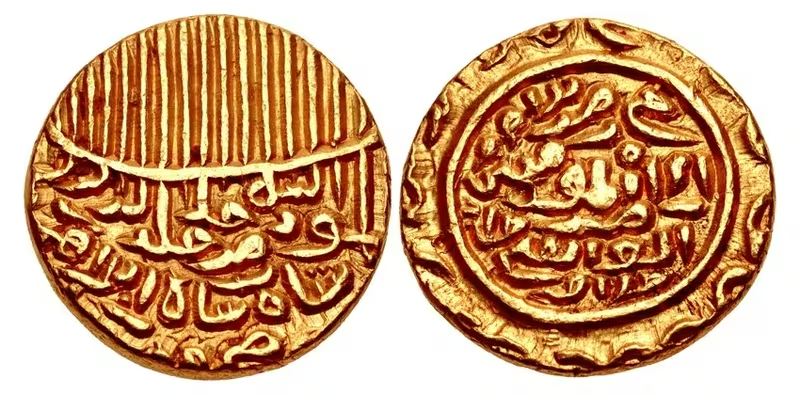
The sultanate also expressed its sovereignty through the khutba and coinage. Malik Sarwar and Mubarak Shah did not initially declare complete independence from Delhi, and the first two rulers did not strike coins in their own names. Ibrahim Shah became the first Jaunpur sultan to issue his own coinage in 1402. Later rulers, including Mahmud Shah and Hussain Shah, continued minting billon and copper coins.
Military Campaigns
Jaunpur’s military history was shaped by campaigns in several directions. Malik Sarwar consolidated the state by defeating rebellions in the western and central Ganges plain and extending authority into Bihar. His struggle with the Ujjainiyas of Bhojpur remained unresolved in a simple sense, since their retreat into the forests allowed resistance to continue.
Under Ibrahim Shah, the sultanate reached Kanauj and threatened Delhi. It also confronted Bengal under Raja Ganesha, with the support or influence of the Muslim holy man Nur Qutb Alam. Ibrahim’s attempt to conquer Bengal failed, as did his effort to recover Kanauj after Mahmud Shah II’s occupation.
Mahmud Shah Sharqi, who succeeded Ibrahim in 1440, conquered Chunar but failed to capture Kalpi. He also campaigned against Bengal and Odisha. In Odisha, the forces of Kapilendra Deva Gajapati decisively defeated the Jaunpur army. Mahmud’s most important western campaigns were directed against Bahlul Lodi. He invaded Delhi in 1452 but was defeated. After another attempt involving Etawah, he accepted a treaty recognising Bahlul’s right to Shamsabad.
When Bahlul tried to take possession of Shamsabad, Jaunpur resisted. Mahmud died during this crisis, and his son Bhikhan succeeded him under the title Muhammad Shah. Muhammad made peace with Bahlul and recognised his right to Shamsabad, but conflict within the ruling family soon destabilised his reign. After Muhammad ordered the execution of his brother Hasan, another brother, Hussain, rebelled and proclaimed himself sultan. Muhammad was killed by Hussain’s army at Kanauj in 1458.
Hussain Shah signed a four-year peace treaty with Bahlul Lodi, but the truce did not end the rivalry. In 1478, Hussain marched towards Delhi with a large army and reached the Yamuna. Bahlul offered to retain only Delhi and govern it as Hussain’s vassal, but Hussain rejected the proposal. Bahlul crossed the Yamuna and defeated him.
Hussain captured Etawah and renewed his march towards Delhi, only to suffer another defeat. In March 1479, he again reached the Yamuna and was defeated. Jaunpur lost the parganas of Kampil, Patiali, Shamsabad, Suket, Koil, Marhara, and Jalesar. Further defeats at Senha, Rapri, and Raigaon Khaga were followed by a final defeat on the banks of the Rahab. Bahlul appointed Mubarak Khan to govern Jaunpur, although Hussain later reassembled his forces, expelled him, and temporarily reoccupied the city.
Cultural Contributions
Sharqi Jaunpur became associated with scholarship, architecture, and music. Its reputation as the “Shiraz of India” reflected the patronage of learning under the sultans, particularly Ibrahim Shah. Colleges were established, and works on Islamic law and theology were composed during his reign.
The architecture of the period is especially distinctive. The Atala Masjid was founded under Firuz Shah Tughluq in 1376 but completed during Ibrahim Shah’s reign in 1408. Ibrahim also built the Jhanjhari Masjid in 1430. The Lal Darwaza Masjid was constructed in 1450 under Mahmud Shah, while the Jama Masjid was completed in 1470 during Hussain Shah’s rule. Together, these monuments are the best-known examples of the Sharqi architectural style in Jaunpur.
Hussain Shah’s cultural reputation also includes music. He assumed the title Gandharva and was associated with the development of khayal, a genre of Hindustani classical music. He was credited with composing or developing several ragas, including Malhar-shyama, Gaur-shyama, Bhopal-shyama, Hussaini or Jaunpuri-asavari—now known as Jaunpuri—and Jaunpuri-basant.
Economy and Trade
The available record gives limited information about taxation, markets, agriculture, and long-distance trade. It does, however, provide evidence for a monetary system and for the circulation of Jaunpur’s coins. Coin hoards have mainly been found in the modern states of Uttar Pradesh and Bihar, suggesting that Sharqi coinage circulated across the core regions of the sultanate.
Ibrahim Shah’s coins were issued in gold, silver, and copper. Their inscriptions invoked the authority of the imam and the deputy of the commander of the faithful. Mahmud Shah and Hussain Shah also minted coins, including billon and copper issues. The decision to strike coins in the sultan’s own name was an important expression of political independence.
Tribute and military obligations also linked the court to regional rulers and Rajput chiefs. The acknowledgement of Malik Sarwar by the rulers of Jajnagar and Lakhnauti, including the presentation of elephants, shows that diplomacy and tribute complemented conquest.
Decline and Fall
The decline of the Jaunpur Sultanate resulted primarily from the sustained pressure of the Lodi rulers of Delhi. The Sharqi state remained capable of raising large armies, but repeated defeats reduced its western territories and weakened its ability to threaten Delhi.
Hussain Shah’s reversals were particularly damaging. After losing the parganas west of Jaunpur and suffering defeat on the Rahab, he could no longer maintain stable control over the capital. Although he briefly recovered Jaunpur, Bahlul Lodi drove him out again. In 1486, Bahlul placed his eldest surviving son, Barbak Shah Lodi, on the throne of Jaunpur.
The final Sharqi defeat came at Benares in 1494. Hussain Shah fled to Kahalgaon in modern Bihar, where Sultan Alauddin Husain Shah of Bengal granted him asylum and a pargana. He was allowed to mint his own coins and was promised assistance in recovering his kingdom. He died in 1505, but the independent Jaunpur Sultanate had ended.
Legacy
The Jaunpur Sultanate illustrates how regional states emerged from the fragmentation of Tughlaq power. For a century, its rulers controlled a strategically important part of the Ganges plain and competed with Delhi, Bengal, and Odisha.
Its most visible legacy is architectural. The Atala Masjid, Lal Darwaza Masjid, Jhanjhari Masjid, and Jama Masjid preserve the distinctive Sharqi style. The dynasty also strengthened Jaunpur’s reputation as a centre of Islamic education and literary production. Its coinage records the gradual movement from delegated provincial authority to independent sovereignty.
The cultural memory of the sultanate extends beyond politics. Hussain Shah’s association with khayal and Jaunpuri music connects the Sharqi court with later traditions of Hindustani classical music. Although the dynasty was absorbed into the expanding Lodi state, Jaunpur remained a major historical and cultural centre because of the institutions, monuments, scholarship, and musical associations developed under its rulers.