Overview
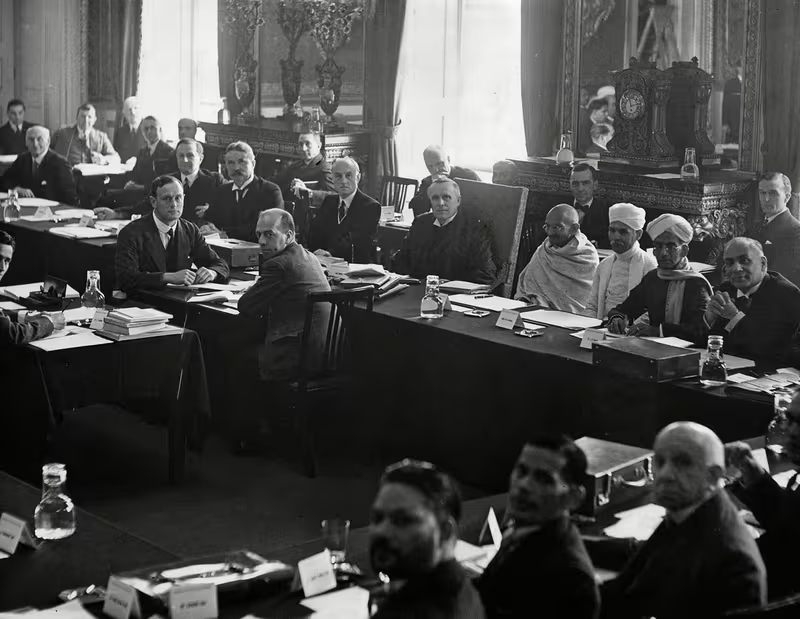
On 12 November 1930, King George V formally inaugurated a constitutional conference in the Royal Gallery of the House of Lords in London. It was the beginning of a three-part attempt to decide how India should be governed. The Round Table Conferences continued through January 1931, resumed in September that year, and concluded with a final session between November and December 1932.
The British Government and Indian political figures used the conferences to discuss constitutional reform at a time when demands for Swaraj, or self-rule, were growing stronger. The central questions concerned the structure of a future Indian constitution, the relationship between British India and the princely states, the powers of provincial and central governments, and the political representation of religious and social communities.
The conferences brought together British politicians, Indian liberals, representatives of the Muslim League, members of the princely states, leaders of minority communities, women, industrialists, labour representatives, landlords, and others. Yet the meetings never achieved a fully inclusive agreement. The Indian National Congress boycotted the first conference, participated through Gandhi alone in the second, and refused to attend the third. Disagreements among Indian representatives were equally important, especially over separate electorates and the political status of the Depressed Classes. The constitutional process nevertheless continued and eventually contributed to the Government of India Act 1935.
Background
By the late 1920s and early 1930s, constitutional reform had become inseparable from the wider demand for Indian self-government. Many British politicians believed that India needed to move towards dominion status, while Indian political leaders pressed for a greater share in determining the country's institutions and policies. The constitutional question was therefore not limited to administrative machinery. It was connected to the larger issue of political authority: who would exercise power, who would be represented, and how far British control would remain intact.
The conferences followed two developments identified in the historical record. Muhammad Ali Jinnah had recommended the idea to Viceroy Lord Irwin and British Prime Minister Ramsay MacDonald, while the Simon Commission submitted its report in May 1930. The British Government then organised a series of meetings designed to bring together the principal political interests connected with India's future.
The timing was difficult. The Civil Disobedience Movement had created a climate of confrontation between the colonial government and the Indian National Congress. Many Congress leaders, including Gandhi, were imprisoned for their participation in the movement when the first conference met. Congress therefore refused to take part. Indian business leaders also stayed away. Their absence meant that the first meeting lacked the participation of the organisation that claimed to speak for the broad nationalist movement.
The British Government nevertheless hoped to construct a constitutional arrangement that could attract support from several sides. The Labour government sought assistance from Liberal and Conservative politicians in Parliament for what it described as a more responsive Indian government at both the central and provincial levels. At the same time, British officials remained concerned about preserving the substance of imperial authority. Sir Samuel Hoare described a federal formula as a way to provide a semblance of responsible government while retaining the realities of British control.
The princely states were central to the federal idea. India was not made up only of provinces directly administered by the British. The princes represented another set of political authorities, each concerned with preserving its internal sovereignty. A federation that included the princely states could create a wider constitutional structure, but it would also have to address the conditions under which the princes would join it.
Prelude
The first conference was convened in London in November 1930. It was chaired by Ramsay MacDonald, who was also Prime Minister. MacDonald chaired a subcommittee on minority representation, while Lord Sankey led the constitutional committee. During MacDonald's work on the conference, his son Malcolm MacDonald performed liaison tasks connected with Lord Sankey's committee.
Several British figures helped shape the discussions. Sir Malcolm Hailey, an Indian civil servant with thirty years of experience, was among the leading advisers. Lord Reading, the leading Liberal on the committee, was conscious of the difficulties that could arise if India became independent. Clement Attlee, who had served on the Simon Commission, supported an early settlement, although the Conservatives in government prevented such a resolution until later. These positions reveal the tensions within British politics: there was discussion of constitutional advance, but no common agreement on the speed or extent of change.
Lord Irwin also made a controversial declaration that India should eventually receive dominion status. Conservatives objected strongly. Winston Churchill argued that the conference had been manipulated by the Socialist Party to achieve responsible government at the centre. The dispute demonstrated that the conference was not only a negotiation between Britain and India. It was also a contest within British politics over the future of imperial government.
Congress participation became the decisive issue after the first meeting. On 26 January 1931, Gandhi and other Congress leaders were released from prison. The discussions that followed produced the Gandhi–Irwin Pact. Under the agreement, the Congress accepted participation in a second constitutional conference. This changed the political character of the proceedings, although it did not resolve the disagreements that had prevented Congress from attending the first session.
The Event
First Round Table Conference: November 1930–January 1931
The first conference was officially inaugurated on 12 November 1930 at the Royal Gallery of the House of Lords. Eight British political parties sent sixteen delegates. British India was represented by fifty-eight political leaders, while the princely states sent sixteen delegates. In total, seventy-four delegates from India attended.
The range of participants was extensive. The British-Indian representatives included Hindus, Muslims, Sikhs, Parsis, Indian Christians, Anglo-Indians, Europeans, women, landlords, labour representatives, university interests, and representatives of different provinces. B. R. Ambedkar and Rettamalai Srinivasan represented the Depressed Classes. Begum Jahanara Shahnawaz and Radhabai Subbarayan represented women. N. M. Joshi and B. Shiva Rao represented labour. The Muslim League delegation included the Aga Khan III, Muhammad Ali Jinnah, Maulana Mohammad Ali Jauhar, Muhammad Shafi, and Muhammad Zafarullah Khan.
The princely states were also strongly represented. The delegates included rulers or representatives connected with Alwar, Baroda, Darbhanga, Bhopal, Bikaner, Dholpur, Jammu and Kashmir, Nawanagar, Patiala, Rewa, Hyderabad, Mysore, and other states. Their participation made clear that any proposed federation would have to accommodate political entities with their own rulers and internal authority.
The proceedings began with six plenary meetings in which delegates presented their principal concerns. Nine subcommittees were then formed. They examined the federal structure, provincial constitutions, Sindh and the North-West Frontier Province, defence services, minorities, franchise, and Burma. Reports from these committees were discussed before two further plenary meetings and a final concluding session.
The central constitutional proposal was an All-India Federation. Tej Bahadur Sapru moved the idea to the centre of the discussion, and all groups attending the conference supported it in principle. The princely states agreed to the proposed federation on the condition that their internal sovereignty would be guaranteed. The Muslim League also supported the concept because it had long opposed the creation of a strong central authority. The British accepted that representative government should be introduced at the provincial level.
These areas of agreement did not overcome the conference's political limitations. Without the Congress, the meeting could not claim to represent the full nationalist movement. The absence of Indian business leaders further narrowed its reach. The debates also showed how difficult it would be to reconcile competing claims to representation. Ramsay MacDonald's diary recorded that India itself had not been considered as much as communal questions and the proportions of reserved seats. The observation reflected the way minority representation came to dominate the proceedings.
The first conference ended in January 1931 without a settlement that could command broad political support. Its discussions did, however, establish federalism and provincial responsibility as central elements of the constitutional debate.
Second Round Table Conference: September–December 1931
The Second Round Table Conference opened on 7 September 1931. It followed the release of Congress leaders and the Gandhi–Irwin Pact. The most important change was the participation of the Indian National Congress. Gandhi attended as its sole official representative. He was accompanied by Sarojini Naidu and other figures, including Madan Mohan Malaviya, Ghanshyam Das Birla, Muhammad Iqbal, Sir Mirza Ismail, S. K. Dutta, and Sir Syed Ali Imam.
The British political setting had also changed. Two weeks before the conference, the Labour government had fallen. Ramsay MacDonald remained Prime Minister, but he now headed a National Government dominated by the Conservative Party. Sir Samuel Hoare had become Secretary of State for India. Britain also went off the Gold Standard during the conference, creating a financial crisis that distracted the National Government.
Gandhi's position produced some of the sharpest disagreements. He claimed that the Congress alone represented political India. He also argued that the Untouchables were part of the Hindu community and should not be treated as a separate minority. On this basis, he opposed separate electorates and special safeguards for Muslims or other minorities. Other Indian participants rejected these claims, arguing that their communities and political interests could not simply be subsumed within Congress's representation.
B. R. Ambedkar was particularly important in the debate over the Depressed Classes. He demanded separate electorates for them. His position differed sharply from Gandhi's view that the Untouchables should remain within the Hindu political community. The disagreement was not merely a dispute over terminology. It concerned whether historically disadvantaged communities would select their own representatives or rely on representatives chosen through a broader electorate.
The conference also continued discussions about the relationship between the executive and the legislature. A future constitutional system would have to determine how far the executive would be responsible to elected representatives and how much authority would remain protected from legislative control. Alongside this question stood the unresolved issue of minority safeguards, which affected Muslims, the Depressed Classes, Sikhs, Indian Christians, Anglo-Indians, and other communities represented at the conference.
At the end of the Second Round Table Conference, Ramsay MacDonald undertook to produce a Communal Award dealing with minority representation. He provided that any free agreement reached among the parties could be substituted for his award. The commitment demonstrated that the conference had not produced agreement on the matter, but it also moved the question towards a formal decision by the British Government.
Gandhi took particular exception to the proposal to treat the Untouchables as a minority separate from the rest of the Hindu community. The All-India Depressed Classes conference specifically denounced his claim. The dispute continued after the conference and was eventually addressed through the Poona Pact of 1932, a compromise between Gandhi and Ambedkar. The conference therefore became part of a wider political struggle over the meaning of representation and the rights of communities within a future Indian polity.
Third Round Table Conference: November–December 1932
The third and final session assembled on 17 November 1932. It was much less inclusive than the second. Only forty-six delegates attended. Most of the main political figures from India were absent, the Labour Party in Britain refused to participate, and the Indian National Congress again stayed away.
The Indian States were represented by figures such as Dewan Kishen Pershad of Hyderabad, Mirza Ismail of Mysore, V. T. Krishnamachari of Baroda, representatives connected with Jammu and Kashmir, and delegates from Udaipur, Jaipur, Jodhpur, Kolhapur, Bhopal, Bikaner, Patiala, Alwar, Nawanagar, and smaller states.
British-Indian participation included the Aga Khan III, Muhammad Iqbal, B. R. Ambedkar, Ramakrishna Ranga Rao of Bobbili, Henry Gidney, M. R. Jayakar, Tej Bahadur Sapru, Arcot Ramasamy Mudaliar, Begum Jahanara Shahnawaz, N. M. Joshi, Sir Purshottamdas Thakurdas, and Muhammad Zafarullah Khan. The range of interests remained broad, but the absence of Congress and Labour reduced the conference's political weight.
Like the first two conferences, the third did not produce a fruitful or inclusive settlement. Its importance lay less in a dramatic agreement than in the continuation of the constitutional process. From September 1931 until March 1933, the proposed reforms were developed under the supervision of the Secretary of State for India, Sir Samuel Hoare. The resulting proposals were reflected in the Government of India Act 1935.
Participants
British Government and Political Parties
Ramsay MacDonald chaired the conferences and played a central role in the discussions on minority representation. The British delegation included members of the Labour, Conservative, Liberal, and Scottish Unionist traditions. Lord Sankey chaired the constitutional committee, while figures such as Samuel Hoare, Lord Reading, Lord Lothian, Earl Peel, Wedgwood Benn, Arthur Henderson, William Jowitt, and Oliver Stanley participated in different sessions.
Their positions were not identical. Some British politicians supported an early constitutional settlement or a move towards responsible government. Others feared that rapid change would weaken British control. The conservative response to dominion status and central responsibility showed that Britain's policy towards India was itself contested.
Indian National Congress
The Congress did not attend the First Round Table Conference. Gandhi and other Congress leaders were imprisoned during the Civil Disobedience Movement, and the organisation's boycott deprived the conference of its most prominent nationalist force.
After the Gandhi–Irwin Pact, Congress participated in the second conference. Gandhi was its sole official representative, although other Indian figures accompanied him. His claim to speak for political India brought him into direct conflict with representatives who rejected Congress's authority to represent their communities. Congress again refused to attend the third conference.
Muslim Representatives
Muslim political representatives took part in all three stages of the constitutional process. The Aga Khan III led the British-Indian Muslim delegation at the first conference. Muhammad Ali Jinnah, Muhammad Shafi, A. K. Fazlul Huq, Muhammad Zafarullah Khan, and many others also participated.
The Muslim League supported an All-India Federation partly because it opposed a strong central government. Muslim representatives also took part in the debates over separate electorates and safeguards. Their position was one of the principal reasons the question of minority representation remained central to the conferences.
Depressed Classes
B. R. Ambedkar and Rettamalai Srinivasan represented the Depressed Classes at the first conference, and Ambedkar continued to participate in the later discussions. Ambedkar demanded separate electorates, arguing for a distinct political mechanism through which the Depressed Classes could choose representatives.
Gandhi rejected the treatment of the Untouchables as a separate minority. The disagreement between the two leaders continued beyond the conference and was eventually addressed through the Poona Pact in 1932. Their conflicting positions revealed the limits of speaking of Indian representation as a single issue: political freedom, social equality, and electoral safeguards were closely connected but not easily reconciled.
Liberals and Other Indian Interests
Liberal leaders such as Tej Bahadur Sapru, V. S. Srinivasa Sastri, C. Y. Chintamani, and M. R. Jayakar played an important role in developing constitutional proposals. Sapru's advocacy of an All-India Federation helped make federalism the organising idea of the discussions.
The conferences also included representatives of the Justice Party, Sikhs, Parsis, Indian Christians, Anglo-Indians, Europeans, women, labour, universities, landlords, industry, Burma, Sindh, and different provinces. The princely states sent rulers, ministers, and advisers. This broad representation allowed many political and social interests to present their claims, even though the lack of Congress participation weakened the conferences' inclusiveness.
Aftermath
The immediate outcome was not a constitutional agreement accepted by all major parties. The first conference had achieved some progress on federalism and provincial representative government, but Congress's absence prevented a broad settlement. The second conference brought Gandhi into the discussions but exposed major divisions over the representation of minorities and the Depressed Classes. The third session, with only forty-six delegates, was unable to repair the loss of political inclusiveness.
The question of minority representation moved towards the Communal Award promised by Ramsay MacDonald. The disagreement over the Depressed Classes continued until the compromise between Gandhi and Ambedkar represented by the Poona Pact of 1932.
The constitutional process did not stop when the conferences ended. A Joint Committee was established to present the recommendations as a Bill. Under Sir Samuel Hoare's supervision, the proposals took the form that was eventually reflected in the Government of India Act 1935.
Historical Significance
The Round Table Conferences were significant because they brought constitutional questions into a formal forum that included British politicians, Indian political organisations, the princely states, and many community representatives. Their discussions demonstrated that the future of India could not be settled by considering only the relationship between the British Government and the Congress.
Federalism became the most important area of agreement. The proposed All-India Federation offered a structure in which British Indian provinces and princely states might be brought together. Yet the princes insisted that their internal sovereignty be protected, while the Muslim League supported federation because it opposed a strong central authority. The same proposal therefore carried different meanings for different participants.
The conferences also established the importance of provincial government. The British agreed that representative government should be introduced at the provincial level. At the same time, the debates over executive responsibility showed that the question of power at the centre remained unresolved.
Most importantly, the meetings exposed the difficulty of creating a common definition of political India. Gandhi's claim that Congress alone represented the country was rejected by other participants. Muslim representatives, Ambedkar, Sikhs, Indian Christians, Anglo-Indians, women, labour representatives, and others insisted that their interests required direct recognition. The debate over separate electorates showed how constitutional design was inseparable from social inequalities and communal political claims.
The conferences therefore produced neither the complete self-government sought by nationalists nor a fully accepted constitutional settlement. Their lasting institutional consequence was the continuation of the process that led to the Government of India Act 1935.
Legacy
The legacy of the Round Table Conferences lies in the constitutional framework they helped develop and in the disagreements they made visible. They placed federation, provincial representation, minority safeguards, and the position of the princely states within a single constitutional conversation.
They also remain associated with Gandhi's appearance in London in 1931 as the sole official Congress representative. His participation gave the Second Round Table Conference a prominence that the other sessions did not possess, but it did not bridge the differences between Congress and other Indian representatives.
Ambedkar's intervention ensured that the political claims of the Depressed Classes could not be treated as a secondary question. The dispute with Gandhi continued into 1932 and contributed to the Poona Pact. In this way, the conferences formed one stage in the longer argument over representation, caste, community, and political equality.
Historiography
The conferences can be interpreted in more than one way. From one perspective, they represented a serious attempt to construct a constitutional arrangement through negotiation. They included a wide range of Indian interests and achieved agreement in principle on an All-India Federation and provincial representative government.
From another perspective, their limitations were fundamental. The first and third conferences lacked Congress participation, while the second gave the organisation only one official representative. The British Government also retained strong concerns about preserving control. Sir Samuel Hoare's federal formula was described as a means of providing a semblance of responsible government while retaining the realities of British authority.
The conferences also reveal disagreements within Indian politics rather than a simple British-Indian divide. Gandhi and Ambedkar disagreed over the political status of the Depressed Classes. Muslim representatives challenged Congress's claim to speak for all India. The princes supported federation only with guarantees for their internal sovereignty. These conflicts meant that the constitutional question involved several competing political futures.
Their failure should therefore not be measured only by the absence of an immediate agreement. The meetings helped define the issues that the Government of India Act 1935 attempted to address, even though the resulting arrangements did not settle the deeper political disagreements.
Timeline
First Conference Inaugurated
King George V officially opens the First Round Table Conference at the Royal Gallery of the House of Lords on 12 November.
First Conference Concludes
The first session ends after discussions on federal structure, provincial constitutions, minorities, franchise, defence, Sindh, Burma, and the North-West Frontier Province.
Congress Participation Agreed
After Gandhi and other Congress leaders are released, discussions lead to the Gandhi–Irwin Pact and Congress acceptance of participation in a second conference.
Second Conference Opens
The Second Round Table Conference opens on 7 September, with Gandhi attending as the sole official representative of the Indian National Congress.
Minority Question Remains Unresolved
Disagreements over Muslim representation, the Depressed Classes, separate electorates, and executive responsibility continue; MacDonald undertakes to produce a Communal Award.
Third Conference Opens
The final session assembles on 17 November with forty-six delegates; the Labour Party and Indian National Congress do not attend.
Conferences End
The third session concludes in December without an inclusive settlement, while the constitutional process continues under Sir Samuel Hoare.
Government of India Act
Recommendations developed through the constitutional process are eventually enacted in the Government of India Act 1935.