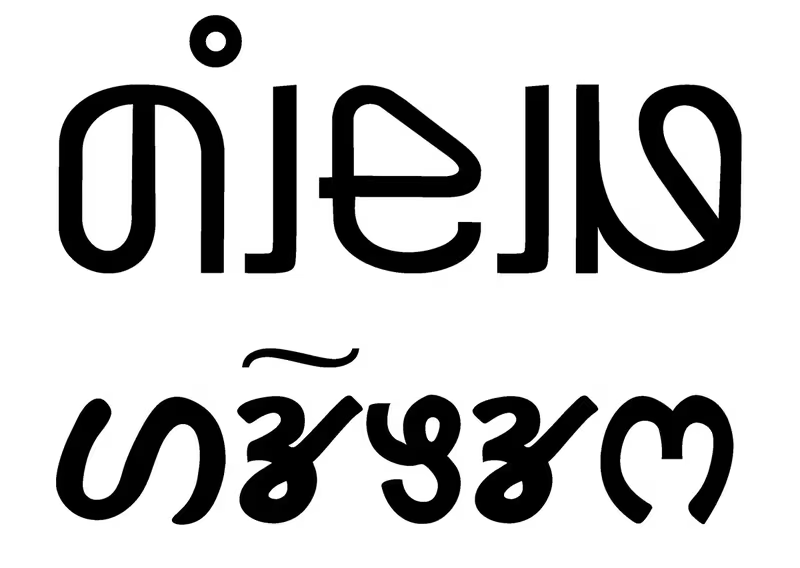
Kurukh Language: A North Dravidian Voice with Multiple Writing Traditions
In 1991, Basudev Ram Khalkho released the Kurukh Banna script in Odisha, adding a dedicated writing system to the traditions already associated with Kurukh. Eight years later, Narayan Oraon invented Tolong Siki specifically for the language; books and magazines followed, and Jharkhand officially recognized the script in 2007. These developments belong to the recent history of Kurukh, a North Dravidian language spoken by the Kurukh, or Oraon, and Kisan peoples.
Kurukh is spoken mainly in eastern and central India, especially in Jharkhand, Chhattisgarh and Odisha. It also has speakers in West Bengal, Assam and Tripura, as well as in Bangladesh, Nepal and Bhutan. About 2,053,000 people speak the language among the Oraon and Kisan communities. Despite this substantial population, Kurukh is considered endangered and is listed as “vulnerable” by UNESCO. Its continued development is visible in school education, state recognition, literary organizations, new scripts and published materials.
The language is also notable for its structure. Kurukh is agglutinative, places the verb at the end of the sentence, and forms words through suffixation rather than prefixes or infixes. Its pronoun system preserves features associated with Proto-Dravidian and distinguishes between “we” including the listener and “we” excluding the listener.
Origins and Classification
Linguistic Family
Kurukh belongs to the Northern Dravidian branch of the Dravidian language family. Its closest related language is Malto, and Kurukh, Malto and Brahui are identified with the North Dravidian branch. Kurukh is also described as closely related to Sauria Paharia and Kumarbhag Paharia, which are often referred to together as Malto.
The language is spoken by Kurukh, also known as Oraon, and Kisan communities. The Kisan variety had approximately 206,100 speakers in 2011. The two principal varieties, Oraon and Kisan, have 73% intelligibility between them. Oraon is being standardized, while Kisan is endangered and declined by 12.3% between 1991 and 2001.
Origins
A precise date and place of origin are not established in the available historical description. Kurukh is instead identified through its position within the North Dravidian group and through grammatical features that preserve ancient Proto-Dravidian structures. Its pronominal system is described as strongly preserving these structures while remaining free from neighboring Indo-Aryan grammatical influences.
Name Etymology
The language is known by several names, including Kurukh, Kurux, Kuṛux, Kuruḵẖ, Kunrukh, Kurka, Kadukali, Urang, Oraon, Uraon, Urāo and Orāỗ. Other designations include Dhakad, Dhangad, Dhanka, Kuda, Dhangar, Kisan, Malto, Berga, Dhangri and Khendroi, although some scholars regard several of these names as synonymous with Kurukh.
According to Edward Tuite Dalton, “Oraon” is an exonym assigned by neighboring Munda people and means “to roam.” The people themselves call the language Kurukh. Sten Konow connected Uraon with the Dravidian Kurukh words Urapai, Urapo and Urang, meaning “man.” Another proposed explanation derives Kurukh from kur or kurcana, associated with “shout” and “stammer,” giving the possible meaning “a speaker.”
The terminology also varies geographically. George van Driem reported a Dhangar and Jhangar dialect in the eastern Nepalese Terai. East of the Kosi River it was called Jhangar, while west of the river it was called Dhangar. Kamil Zvelebil and Ethnologue, however, treated the Nepalese Dhangar as distinct from Kurux proper.
Historical Development
Traditional Kurukh
Kurukh belongs to a long-standing Dravidian linguistic tradition, but the available account does not establish a chronological sequence of early, medieval and modern stages. Its grammatical structure provides important evidence of its linguistic character. Kurukh is agglutinative: grammatical meanings are built through the addition of suffixes. Its basic sentence order is Subject–Object–Verb, and its morphological construction uses suffixation without infixes or prefixes.
The language has three grammatical genders: masculine, feminine and neuter. Men are masculine; women and goddesses or evil spirits are feminine; all other nouns are neuter. It has two grammatical numbers, singular and plural. Masculine third-person singular nouns may have indefinite and definite forms. For example, āl means “man,” while ālas means “the man.” Feminine declension is almost identical to masculine declension but lacks a definite form. Neuter nouns have similar singular forms but differ in pluralization.
Modern Documentation and Standardization
Kurukh is documented through grammars, dictionaries, folklore collections and more recent literary publications. Ferdinand Hahn published Kurukh grammatical and lexical works, including Kurukh Grammar and a Kurukh–English dictionary. The language also appears in books, magazines and educational materials written in several scripts.
In 1991, Basudev Ram Khalkho released Kurukh Banna in Odisha. The script was taught and promoted by Kurukh Parha in Sundargarh district. Fonts were developed, and the alphabet came to be used widely in books, magazines and other materials. It was also used by Oraon people in Chhattisgarh, West Bengal, Jharkhand and Assam.
In 1999, Narayan Oraon, a doctor, invented Tolong Siki as an alphabetic script specifically for Kurukh. Many books and magazines have since been published in it. Jharkhand officially recognized Tolong Siki in 2007, and the Kurukh Literary Society of India helped spread the script for Kurukh literature.
Modern Period
The governments of Jharkhand and Chhattisgarh introduced Kurukh in schools with majority Kurukhar student populations. Kurukh is taught as a subject in schools in Jharkhand, Chhattisgarh, Madhya Pradesh, Odisha, West Bengal and Assam. Jharkhand and West Bengal list Kurukh as an official language of their respective states.
Scripts and Writing Systems
Devanagari
Kurukh is written in Devanagari, the script also used for Sanskrit, Hindi, Marathi, Nepali and other Indo-Aryan languages. A sample Kurukh passage is presented in Devanagari alongside a Latin transliteration. This demonstrates the use of Devanagari for contemporary Kurukh writing and makes the language accessible through a script familiar across several South Asian linguistic communities.
Kurukh Banna
Kurukh Banna was released in 1991 by Basudev Ram Khalkho of Odisha. In Sundargarh district, Kurukh Parha taught and promoted the alphabet. Fonts were developed for it, and the script was used in books, magazines and other materials. Its use extended beyond Odisha to Oraon communities in Chhattisgarh, West Bengal, Jharkhand and Assam.
Tolong Siki
Tolong Siki is an alphabetic script created specifically for Kurukh by Narayan Oraon in 1999. Its publication history includes books and magazines, and it received official recognition from Jharkhand in 2007. The Kurukh Literary Society of India has played an important role in promoting Tolong Siki for Kurukh literary work.
Script Evolution
Kurukh therefore has more than one contemporary writing tradition. Devanagari connects it with a widely used South Asian script, while Kurukh Banna and Tolong Siki represent efforts to provide writing systems closely associated with Kurukh identity and literary production. The available account does not establish an earlier chronological script history before Devanagari, Kurukh Banna and Tolong Siki.
Geographic Distribution
Historical Spread
Kurukh is associated with the Kurukh or Oraon and Kisan peoples of eastern India. The language is also spoken by communities beyond India, including approximately 65,000 people in northern Bangladesh, 28,600 speakers of a dialect called Uranw in Nepal and about 5,000 speakers in Bhutan.
Modern Distribution
In India, Kurukh is spoken mainly in Raigarh, Surguja and Jashpur in Chhattisgarh; Gumla, Ranchi, Lohardaga, Latehar and Simdega in Jharkhand; and Jharsuguda, Sundargarh and Sambalpur in Odisha. It is also spoken in Jalpaiguri district of West Bengal and in Assam and Tripura, where many Kurukh speakers are tea-garden workers.
Literary Heritage
Grammar, Dictionaries and Folklore
Kurukh’s documented literary heritage includes grammatical, lexical and folklore publications. Ferdinand Hahn’s works include Kurukh Grammar, a Kurukh–English dictionary and a collection of Kurukh folklore in the original language. Later publications have appeared in Devanagari, Kurukh Banna and Tolong Siki.
Contemporary Publications
Many books and magazines have been published in Tolong Siki. Kurukh Banna has also been used in books, magazines and other materials. These publications are part of the language’s modern literary development and of efforts to strengthen written Kurukh.
Sample Text
A sample Kurukh text presents the idea that all human beings are born free and equal in dignity and rights. It is given in both Devanagari and Latin script. The Latin rendering begins:
Hōrmā ālārin hak gahi bāre nū mallintā azādi arā aṅṭēm mannā gahi haq xakharki raī.
The example illustrates the coexistence of Devanagari writing and Latin transliteration in the presentation of Kurukh.
Grammar and Phonology
Key Features
Kurukh is an agglutinative language with Subject–Object–Verb sentence order. It uses suffixation and has no infixes or prefixes. The language has masculine, feminine and neuter grammatical genders, and singular and plural numbers.
Its pronoun system is highly regular and agglutinative. Personal pronouns distinguish singular and plural and preserve long vowels in their basic nominative forms. The first-person plural has a strict clusivity distinction: ēm means “we” excluding the listener, while nām means “we” including the listener.
Kurukh uses a five-vowel demonstrative system for third-person reference rather than independent third-person roots. Distal ā-, proximal ī- and medial ū- bases express physical distance, while interrogative ē- and relative ō- bases handle conversational relationships. The reflexive pronouns tān, singular, and tām, plural, can also function as logophoric pronouns in reported speech.
Sound System
Kurukh has five cardinal vowels. Each vowel has short, long, short nasalized and long nasalized counterparts.
Its consonant system includes contrasts involving voiced aspirates and /h/. Medially, voiced aspirates and voiced plosives followed by /h/ can contrast, as in /dʱandha:/ “astonishment” and /dʱandʱa:/ “exertion.” Clusters of voiced aspirates and /h/ also occur, including forms meaning “middle” and “zamindar’s agent.”
Among the nasals, /m/ and /n/ are phonemic. The retroflex nasal [ɳ] occurs before retroflex plosives. The velar nasal /ŋ/ generally occurs before other velars but may occur finally when a preceding /g/ is deleted. The language also has cases in which /ŋg/ and /ng/ contrast. The palatal nasal /ɲ/ mostly occurs before postalveolars, while /j/ can become /ɲ/ around nasal vowels.
Influence and Legacy
Dravidian Connections
Kurukh’s principal linguistic significance lies in its position within the North Dravidian branch. Its closest relationship is with Malto, while Brahui is also included in the North Dravidian grouping. Its pronouns preserve ancient Proto-Dravidian structures, and the system is described as largely free from neighboring Indo-Aryan grammatical influence.
Cultural Impact
Kurukh remains an important language of Oraon and Kisan communities. Its presence in schools, official language policy, literary organizations, magazines and newly developed scripts demonstrates continuing cultural activity. At the same time, UNESCO’s classification of Kurukh as vulnerable and the endangered status of Kisan highlight the challenges facing the language.
Modern Status
Current Speakers
Kurukh is spoken by approximately 2,053,000 people from the Oraon and Kisan tribes. The figure includes about 1,834,000 Oraon speakers and 219,000 Kisan speakers. The wider Kurukh-speaking population includes communities in India, Bangladesh, Nepal and Bhutan.
Literacy rates are reported as 23% among Oraon speakers and 17% among Kisan speakers. Kisan is currently endangered, with a reported decline of 12.3% from 1991 to 2001.
Official Recognition
Jharkhand and West Bengal list Kurukh as an official language. Jharkhand officially recognized the Tolong Siki script in 2007. Kurukh is also taught in schools across Jharkhand, Chhattisgarh, Madhya Pradesh, Odisha, West Bengal and Assam.
Preservation Efforts
Preservation efforts include teaching Kurukh in schools, promoting Kurukh Banna, developing and using Tolong Siki, publishing books and magazines, and the work of the Kurukh Literary Society of India. Kurukh Parha has promoted Kurukh Banna in Sundargarh district. These efforts address both literacy and the need for written materials in the language.
Learning and Study
Academic Study
Kurukh has been studied through grammars, dictionaries, folklore collections and linguistic descriptions. Ferdinand Hahn’s publications include Kurukh Grammar, a Kurukh–English dictionary and a Kurukh folklore collection. Modern linguistic study also examines Kurukh’s classification, dialects, pronouns, morphology, phonology and writing systems.
Resources
Learners and researchers can consult Kurukh grammars, the Kurukh–English dictionary, folklore in the original language, basic lexical materials and publications in Devanagari, Kurukh Banna and Tolong Siki. Books and magazines in Tolong Siki provide additional contemporary reading material.
Conclusion
Kurukh is a North Dravidian language with a broad geographic presence and a distinctive grammatical profile. Spoken by Oraon and Kisan communities, it combines agglutinative morphology, Subject–Object–Verb syntax, three grammatical genders and a precise distinction between inclusive and exclusive “we.” Its historical identity is also expressed through several writing traditions: Devanagari, Kurukh Banna and Tolong Siki.
The language’s modern development is especially visible in the release of Kurukh Banna in 1991, the invention of Tolong Siki in 1999 and Jharkhand’s recognition of Tolong Siki in 2007. Schools, literary organizations, books and magazines support its continued use. Yet UNESCO’s vulnerable classification and the decline of Kisan show that speaker numbers alone do not guarantee security. Kurukh’s future depends on the continued connection between community use, education, literacy and literary production.