Overview
Around 625 CE, a new ruling house emerged in the Kashmir valley after a period associated with Huna power. The Karkota dynasty ruled Kashmir and parts of the northern Indian subcontinent for roughly two centuries, until the rise of the Utpala dynasty around 855. Its history combines political expansion, regional diplomacy, economic activity, temple building, Buddhist institutions, and an unusually rich literary culture.
The dynasty is especially associated with Lalitaditya Muktapida, whose reign in the eighth century became the centre of Kashmir's historical memory. The eleventh-century historian Kalhana credited Lalitaditya with conquests extending across India, Afghanistan, and Central Asia. Modern historians disagree about how much of this account can be accepted. Some have treated the campaigns as broadly historical, while others, comparing Kalhana with Chinese, Tibetan, numismatic, and pilgrimage records, regard the description as greatly exaggerated. The debate itself illustrates the difficulty of reconstructing early medieval Kashmir.
Karkota political history is preserved through several different kinds of evidence. The Rajatarangini, written by Kalhana several centuries later, gives the fullest narrative. The Nilamata Purana and Vishnudharmottara Purana preserve local religious and political traditions, while Buddhist pilgrims—including Xuanzang, Yijing, Wukong, and Hyecho—record observations connected with Kashmir. Chinese court histories provide important information about diplomatic relations. Coins, inscriptions, surviving sculptures, and ruined religious buildings add material evidence, although the surviving record does not resolve every disagreement about dates or events.
Rise to Power
The precise establishment of the Karkota dynasty remains debated. Kalhana's account presents Durlabhavardhana as a subordinate connected with Baladitya, whom it identifies as the last ruler of a Gonanda dynasty. According to this narrative, Baladitya had no son and arranged the marriage of his daughter Anaṅgalekhā to Durlabhavardhana. After Baladitya's death, Durlabhavardhana gained the throne with the assistance of a minister and claimed descent from the mythical Naga king Karkotaka.
This account cannot be accepted without qualification. The early books of the Rajatarangini contain long reigns, duplicated or rearranged names, and stories that seem to compress events separated by centuries. The chronological scheme is also difficult to reconcile with coins and inscriptions. For this reason, scholars have proposed different reconstructions of the transition from Huna rule to Karkota rule.
Atreyi Biswas, using numismatic and literary evidence, identifies Durlabhaka Pratapaditya rather than Durlabhavardhana as the first Karkota ruler. In this interpretation, Durlabhavardhana may have been a subordinate under the Huna ruler Narendraditya Khinkhila, while Durlabhaka Pratapaditya took power after defeating Yudhisthira, described as the last Alchon Hun ruler of Kashmir. Other scholars have disputed aspects of this reconstruction, particularly its chronology and its treatment of Narendraditya. The dates and circumstances of the dynasty's foundation should therefore be regarded as approximate.
Durlabhavardhana is conventionally assigned a reign from about 625 to 661 or 662. Kalhana also calls him Prajnaditya and records that he granted numerous villages, or agraharas, to Brahmins. The Rajatarangini does not describe major military campaigns during his reign. Yet, if Xuanzang's visits are placed within this period, Durlabhavardhana may have controlled a substantial territory including Kashmir, Punjab, and parts of present-day Khyber Pakhtunkhwa. This wider extent remains dependent on interpreting the travel records alongside Kalhana's chronology.
The early Karkota state also developed a religious and cultural programme. Durlabhavardhana is associated with the Vishnu shrine of Durlabhasvamin at Srinagar, while his wife is said to have founded the Buddhist monastery of Anangabhavana. These foundations point to a political environment in which Brahmanical and Buddhist institutions existed together rather than replacing one another immediately.
Golden Age
Durlabhaka, also called Pratapaditya, is assigned a long reign from about 662 to 712. Kalhana describes him as the maternal grandson of Baladitya, a detail that belongs to the dynastic genealogy preserved in the Rajatarangini. Durlabhaka's reign saw stronger connections with neighbouring polities, continued establishment of agraharas, and the growth of what scholars describe as a Classical Karkota style in sculpture.
Durlabhaka's wife, Narendraprabhā, had previously been married to Nona, a wealthy merchant from outside Kashmir. Their marriage indicates the prominence of merchant communities in the political and social life of the kingdom. Durlabhaka and Narendraprabhā had three sons: Chandrapida, Tarapida, and Lalitaditya, in that order. Durlabhaka also founded the city of Pratāpapura, identified with modern Tapar between Baramula and Srinagar, and established the shrine of Malhanasvamin. Narendraprabhā is credited with founding the Narendreshvara Temple.
Chandrapida ruled from approximately 712 or 713 to 720 and was also known as Vajraditya. His name appears in Chinese records in the form Zhentuoluobili. Kalhana depicts him as a benevolent and virtuous ruler. In 713, Chandrapida sent an embassy to the Tang emperor Xuanzong requesting assistance against Arab invasions. The Tang court did not provide the requested aid, but Chandrapida apparently defended his territory without it.
The diplomatic relationship nevertheless developed. In 720, Xuanzong sent an envoy to confer on Chandrapida the title “King of Kashmir.” Chinese records also connect Kashmir with Tang military activity in the northwest. After the Tang victory over Tibet in 722, the Chinese court credited Kashmir with supplying food to Tang troops stationed in Gilgit. These exchanges show that Kashmir was integrated into the political world of the Himalayas and Inner Asia, not isolated within its valley.
Chandrapida's reign ended violently according to Kalhana, who states that his brother Tarapida arranged his assassination through a Brahmin. Tarapida, also called Udayaditya, is described as a tyrant who oppressed Brahmins. He ruled for about four years and was then murdered. Kalhana attributes his death to magical rites performed by Brahmins. Chinese records from 724 mention a king of Kashmir who considered assisting a Chinese defector named Jincheng and sought military support from Zabulistan against Tibetan forces. Some scholars identify this unnamed king with Tarapida, while others associate the episode with Chandrapida.
Lalitaditya Muktapida succeeded Tarapida around 724 or 725 and ruled until approximately 760 or 761. His reign is generally regarded as the high point of Karkota power and cultural patronage. Kalhana presents him as a universal conqueror who defeated Yashovarman of Kannauj and subdued territories across northern India, Afghanistan, and Central Asia. He also portrays Lalitaditya as a ruler who defeated the Turks and ruled the world. Al-Biruni, writing about a century after Lalitaditya, noted that Kashmiris celebrated an annual festival in his memory.
The extent of these conquests is one of the most disputed questions in Karkota history. Stein rejected Kalhana's account as largely mythical, arguing that the later historian had limited knowledge of regions beyond Kashmir. Hermann Goetz accepted much more of the narrative as historical, and this interpretation influenced several later scholars. Tansen Sen, comparing Kalhana with Chinese and Tibetan materials, coins, and pilgrimage accounts, supported a more cautious position closer to Stein's. The evidence supports Lalitaditya's importance as a powerful ruler, but it does not establish every conquest attributed to him.
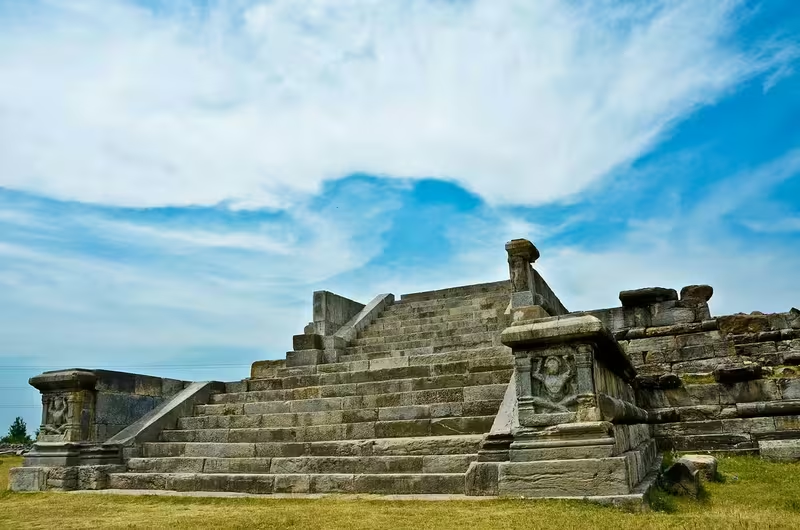
Lalitaditya's reign was also a period of substantial cultural activity. Brahmin immigrants arrived in Kashmir from different regions, and later tradition connected the ancestors of the philosopher Abhinavagupta with this movement. Lalitaditya invited scholars from outside Kashmir to his court and supported the study of religions. He commissioned temples and Buddhist structures, established towns, and founded Parihasapura as a new capital. His most celebrated architectural project was the Martand Sun Temple in the Anantnag district.
Administration and Governance
The Karkota kingdom was a hereditary monarchy, but political power did not always remain firmly in the hands of the king. Ministers, relatives, queens, merchants, and military figures could influence succession and administration. The later history of the dynasty makes this especially clear: after the murder of Cippatajayapida, five brothers connected to his mother Jayadevi controlled the government while placing members of the royal family on the throne.
The grant of agraharas was an important feature of the political order. These were villages or revenue assignments given to Brahmins. Durlabhavardhana is credited with making many such grants, and later rulers continued the practice. Jayapida, however, eventually tried to revoke some of them. His attempt to recover the grants contributed to his conflict with Brahmins and formed part of the negative portrait Kalhana gives of his later reign.
The state collected several kinds of taxes. These included customs duties, market taxes, and a levy connected with prostitution. The literary evidence also suggests that corruption was widespread. Damodaragupta, a court poet, repeatedly mocked corrupt officials and social practices in the Kuttanimata. Such passages should not be read as a complete administrative record, but they reveal contemporary criticism of taxation, officials, and urban life.
Coins issued by the major rulers up to Muktapida and Jayapida have been found. These coins were inscribed in the name of Kidara on the reverse, showing the persistence of an older monetary convention within the Karkota period. Alongside metallic currency, cowrie shells were used in economic transactions.
Military Campaigns
The earliest Karkota rulers inherited a political landscape shaped by Huna power and regional competition. The precise military events of the dynasty's foundation are uncertain, but the transition appears to have followed the decline of Huna authority in Kashmir. Durlabhavardhana's territorial reach may already have extended beyond the valley, although the Rajatarangini does not describe major campaigns under him.
Chandrapida's reign provides the clearest early example of external military pressure. In 713, he requested Tang assistance against Arab invasions. The appeal was unsuccessful, yet Kashmir managed to defend itself. The episode demonstrates the importance of the northwestern frontier and the kingdom's ability to use diplomacy in response to military threats.
Relations with Tang China became closer during the following decade. The recognition of Chandrapida by the Tang court and the later reference to Kashmiri food supplies for Tang troops in Gilgit suggest cooperation against Tibetan influence. The precise form of the alliance is not fully clear, but Kashmir's position made it a valuable participant in the political struggles of the region.
Lalitaditya's campaigns are more difficult to assess. Kalhana attributes to him a series of victories that would have made Karkota power extraordinarily extensive. The narrative includes the defeat of Yashovarman of Kannauj and campaigns beyond the Indian subcontinent. Some scholars have accepted the broad outline, while others argue that later Kashmiri memory magnified a successful regional ruler into a world conqueror. Contemporary Chinese and Tibetan evidence does not confirm every campaign named by Kalhana.
Jayapida, also known as Vinayaditya, ruled for about thirty-one years and conducted campaigns in distant regions in an apparent attempt to rival Lalitaditya's reputation. Kalhana describes his journeys and victories at length, but the absence of corroborating records from many of the regions mentioned requires caution. During one campaign, Jayapida married Kalyanadevi, daughter of the ruler of Cooch Behar. On returning to Kashmir, he found that his brother-in-law Jajja had seized the throne. Jayapida defeated Jajja and recovered power.
The later military history of the dynasty was shaped less by external conquest than by internal factional conflict. After Cippatajayapida was murdered around 840, the five brothers of Jayadevi fought for control while appointing rival Karkota princes. Utpala defeated Mamma and installed Anangipida; later, Utpala's son Sukhavarman installed Utpalapida. These struggles weakened central authority and allowed merchants at outlying posts to declare independence.
Cultural Contributions
Religion and Sacred Architecture
The Karkota period supported both Brahmanical and Buddhist institutions. The rulers constructed numerous Vishnu shrines, while Buddhist monasteries, stupas, chaityas, and viharas continued to flourish. The remains of these structures around the former capital demonstrate the coexistence of different religious traditions. The dynasty's earlier rulers are sometimes described as seeking to restore Hinduism after a long period of Buddhist influence, but the surviving evidence points to a syncretic environment rather than a simple religious replacement.
Durlabhavardhana's Durlabhasvamin shrine was dedicated to Vishnu, while Anangabhavana, founded by his wife, was a Buddhist monastery. Durlabhaka established the shrine of Malhanasvamin, and Chandrapida is credited with founding several Vishnu temples. Jayapida established Buddhist viharas and commissioned Buddha images.
Lalitaditya's building programme was particularly extensive. He commissioned numerous shrines in Kashmir, including the Martand Sun Temple, and supported Buddhist structures as well. The Martand complex, now ruined, was one of the largest temple complexes of its time and is the oldest known Sun temple in India according to the historical account preserved here. Lalitaditya also founded several towns and established Parihasapura as a new capital.
During the final phase, the five powerful brothers associated with Cippatajayapida founded the Shiva shrine of Jayeshvara. They later commissioned additional temples and settlements, including Utpalasvamin, Padmasvamin, Dharmasvamin, Kalyanasvamin, Mamasvamin, Utpalapura, and Padmapura. Padma's wife is said to have built two monasteries.
Sculpture
Karkota Kashmir witnessed significant growth in sculpture. The Rajatarangini refers to numerous bronze images, and Lalitaditya is credited with commissioning gold and silver images for temples and monasteries belonging to different faiths. His reign is often considered the high point of Kashmiri sculpture.
Terracotta works, particularly faces, have also been found from the period. Stone sculptures associated with Durlabhaka have been excavated. The development of a distinctive Karkota style drew on post-Gupta artistic trends from centres such as Sarnath and Nalanda. This combination of external artistic influences and local production helped give Kashmir a recognisable place in the history of South Asian art.
Literature and Scholarship
The Nilamata Purana is believed to have been commissioned by Durlabhavardhana. It presents Kashmir as a sacred geographical and religious space and legitimises the ruler's place within that sacred order. Because the text contains later interpolations, including additions as late as the tenth century, it should not be treated as an objective political chronicle.
The Vishnudharmottara Purana is another local work associated with the period. It played a similar role in articulating religious and cultural ideas within the Karkota polity. Buddhist pilgrims supplied a different kind of testimony. Xuanzang visited Kashmir between May 631 and April 633, while Yijing travelled during 673–685. Wukong, Hyecho, and other pilgrims also recorded observations connected with the region.
Jayapida's court became especially important for Sanskrit literary theory. The poet Damodaragupta wrote the Kuttanimata, a didactic work on erotics that also provides a lively picture of Kashmiri society. Jayapida is credited with inviting scholars from outside Kashmir. Vāmana served as a minister and Udbhata as chief scholar. Their works addressed poetic theory, literary practice, semantics, aesthetics, and the relationship between language and meaning.
Udbhata wrote a poem on the marriage of Shiva and Parvati, a commentary on Bhāmaha's Kavyalankara, a now-lost commentary on the Natyashastra, and a largely lost work called Vivarana. Vāmana composed aphoristic works on poetics. Scholars have described Jayapida's court as a turning point in the development of Kashmiri literary criticism.
Other figures associated with the intellectual culture of the dynasty included the grammarian Kshira, the poets Manoratha, Shankhadatta, Chataka, and Sandhimat, and the Buddhist philosopher Dharmottara. Under Cippatajayapida, Ratnakara composed Haravijaya, a fifty-canto poem of 4,351 verses concerning Shiva's defeat of Andhaka. It is the largest surviving Mahakavya.
Economy and Trade
The Karkota economy used metallic coins and cowrie shells. Coins circulated under conventions that retained the name of Kidara on the reverse, even when issued by later Karkota rulers. The evidence indicates an economy connected to both local exchange and longer-distance commerce.
Durlabhaka's reign saw increasing trade relations with neighbouring polities. Merchant communities were influential within Kashmiri society, and the Kuttanimata presents an unequal social order in which merchants played a prominent role. At the end of the dynasty, merchants at frontier outposts declared independence, suggesting that commercial centres could exercise considerable autonomy when royal authority weakened.
Revenue came from customs duties, market taxes, and other levies, including a tax associated with prostitution. The state also benefited from land assignments and the control of towns. The establishment of Pratāpapura, Jayapura, Parihasapura, and later settlements linked political authority with urban and religious foundations.
The surviving literary record presents the elite as strongly materialistic. Hunting was a popular sport among princes, theatres were frequently organised, and dedicated halls existed for performances. Ratnavali was reportedly a popular drama. These details reveal an urban and courtly culture supported by taxation, commerce, patronage, and social inequality.
Decline and Fall
After Lalitaditya, succession became increasingly unstable. His son Kuvalayapida ruled for only about a year and half a month while facing a struggle with his half-brother. Kalhana portrays him as virtuous, but says that after being betrayed by his minister he recognised the futility of material power, abdicated, and retired to a holy forest.
Vajraditya, another son of Lalitaditya, ruled for seven years and is described as cruel. His period saw a successful raid by the governor of Sindh and the introduction of slave trading. Four of his sons later became involved in succession disputes. Prithivyapida I ruled for about four years and one month before being overthrown by his brother Samgramapida I, whose reign lasted only seven days. Their elder brother Tribhuvanapida had already renounced the throne.
Jayapida restored a measure of political energy, but his later rule became authoritarian according to Kalhana. His attempt to revoke agraharas and his harsh taxation of Brahmins caused many to leave Kashmir. Kalhana ends the account with a Brahmin curse that brought about his death. Whether this should be read as literal history or as a moral explanation of tyranny, it reflects the ethical framework of the Rajatarangini.
The next rulers were increasingly dependent on court factions. Lalitapida is condemned for extravagance, a court filled with courtesans, concubines, and jesters, and a failure to patronise learning. Samgramapida II ruled for seven years but left little additional record. Cippatajayapida was crowned around 837 while still young. Effective authority passed to his five maternal uncles—Padma, Utpala, Kalyana, Mamma, and Dharma. Although they followed Jayadevi's orders, their management of affairs was marked by rivalry and misrule.
Cippatajayapida was murdered around 840 after about twelve years on the throne. The five brothers then fought among themselves while installing puppet kings from the Karkota lineage. Utpala first placed Ajitapida, the son of Tribhuvanapida, on the throne. Mamma later defeated Utpala and installed Anangipida. Three years afterward, Utpala's son Sukhavarman rebelled and installed Utpalapida, a son of Ajitapida.
The authority of the kingdom continued to fragment. Merchants declared independence at distant outposts, and Sukhavarman attempted to claim the throne directly. He was murdered by a relative before he could consolidate power. Finally, his son Avantivarman, supported by the minister Sura, deposed Utpalapida around 855. This ended Karkota rule and established the Utpala dynasty.
Legacy
The Karkota dynasty shaped Kashmir's political and cultural identity during a formative period. Its rulers connected the valley to the wider worlds of northern India, Tibet, Central Asia, and Tang China. Their diplomatic activity, especially under Chandrapida, demonstrates Kashmir's role in the strategic politics of the northwest.
The dynasty's religious legacy is equally diverse. Vishnu shrines, Shiva temples, Buddhist monasteries, stupas, chaityas, and viharas were built or supported during the period. The ruins of Parihasapura and the Martand Sun Temple preserve the memory of Karkota ambition, while sculptures and terracotta works reveal the technical and artistic development of Kashmir.
Karkota patronage also contributed to the emergence of Kashmir as a centre of Sanskrit scholarship. The literary debates associated with Jayapida's court helped establish traditions of poetics and literary criticism that would influence the intellectual history of the region. Works such as the Kuttanimata and Haravijaya remain important evidence for courtly culture and Sanskrit literary production.
The dynasty's political history must nevertheless be read critically. The Rajatarangini offers indispensable information but blends chronology, moral judgement, religious imagination, geography, and political narrative. Its account of Lalitaditya's conquests is especially contested, and the early genealogy contains substantial chronological problems. Chinese records, coins, inscriptions, pilgrimage accounts, and archaeology provide essential comparisons. Together, these materials present the Karkotas not as an uncomplicated imperial power, but as a long-lasting Kashmiri dynasty whose achievements and internal conflicts were remembered in dramatically different ways.