Overview
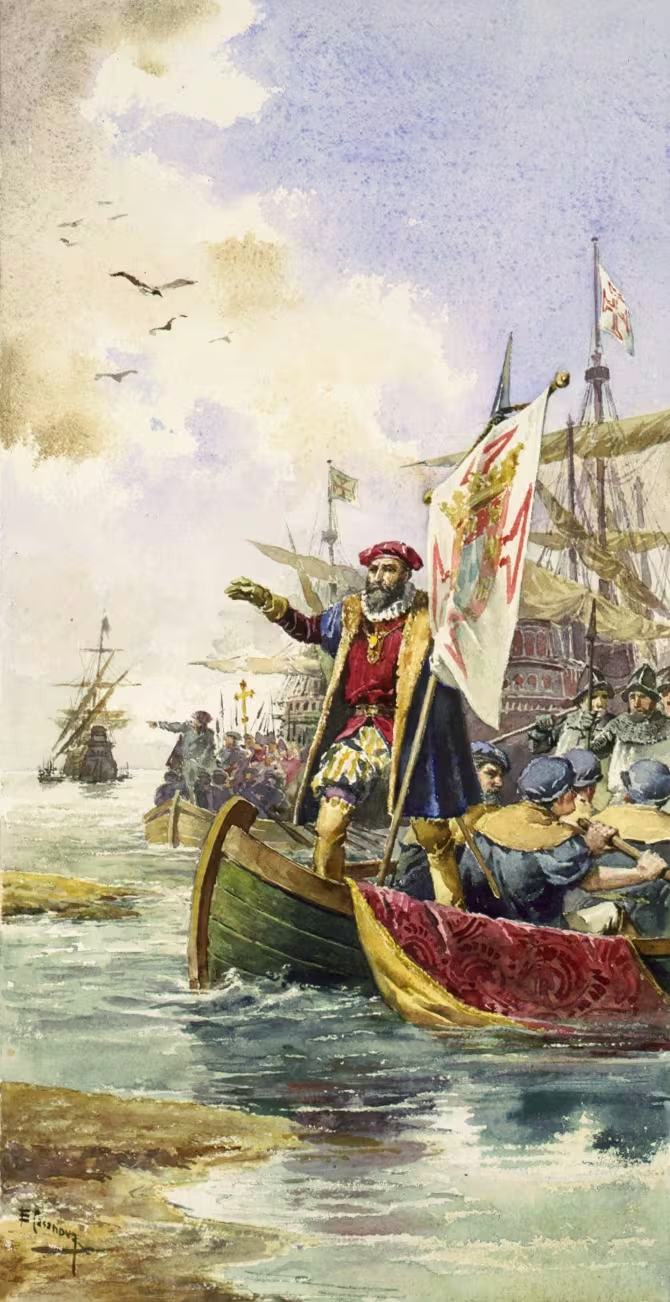
On 8 July 1497, a Portuguese fleet left Lisbon with a demanding objective: reach India by sailing around the southern tip of Africa. More than two years later, the expedition returned to the Tagus after reaching Calicut, on the Malabar Coast, and demonstrating that a direct maritime route between Europe and the Indian subcontinent could be navigated through the Cape of Good Hope and the Indian Ocean.
Led by Vasco da Gama during the reign of King Manuel I, the voyage was the first recorded direct trip from Europe to India by this route. It did not create Indian Ocean commerce; Asian, Arab, African, and Indian merchants had long traded across the region. Its importance lay in connecting Portugal directly to that commercial world by sea. The expedition therefore opened a new phase of Portuguese trade, diplomacy, military activity, and settlement in the Indian Ocean.
The journey was also extraordinarily costly in human terms. Disease, especially scurvy, weakened the crew, and one of the ships had to be abandoned and burned because too few sailors remained to operate it. Of the 148 men who formed the armada, only 55 survived the expedition. Yet the ships that returned brought news that transformed Portugal's position in European maritime competition.
Background
European demand for Asian spices had made products such as cinnamon, ginger, cloves, black pepper, and turmeric extremely valuable. These goods reached Europe through long-established commercial networks. Caravans and experienced merchants carried them overland, while Mediterranean markets, especially Venice and Genoa, distributed them through Europe. The journey was expensive, dangerous, and time-consuming, and Portuguese rulers believed that a direct sea route could allow their kingdom to obtain spices using its own ships.
The plan for reaching India by sailing around Africa was developed during the reign of King John II of Portugal. It served several purposes at once: reducing the cost of Asian trade, expanding Portuguese maritime power, and attempting to gain a larger share of the spice trade. The project was not simply a voyage of exploration. It also anticipated the creation of trading posts and fortresses along the route, together with diplomatic contact with rulers encountered during the journey.
The route became more plausible in 1488, when Bartolomeu Dias passed the southernmost point of Africa. He demonstrated that ships could move beyond the Cape and enter the waters leading toward the Indian Ocean. Dias also helped with the construction of the São Gabriel and its sister ship, the São Rafael, vessels later used on Vasco da Gama's expedition.
The causes of Portuguese expansion have sometimes been explained through the fall of Constantinople to the Ottomans in 1453. A popular interpretation claimed that Ottoman control sharply closed the traditional eastern routes and forced western Europeans to search for alternatives. This explanation was challenged in 1915 by Albert H. Lybyer, who argued that spice prices did not show the dramatic increase that such a disruption would have produced. He also noted that the search for new routes was driven by Atlantic powers and arose from a wider chain of causes rather than from a single Ottoman action.
Portuguese interest also involved hopes of finding powerful Christian rulers in the East. Information gathered around the kingdom of Benin spoke of a distant and influential prince called Ogané. Portuguese officials connected these reports with the older European story of Prester John, a supposed Christian ruler somewhere in the East. Missions were sent to gather information. Frei António de Lisboa and Pedro de Montarroio reached Jerusalem but did not continue because they could not speak Arabic. A later mission involving Afonso de Paiva and Pêro da Covilhã travelled through North Africa, the eastern Mediterranean, Egypt, Aden, Ethiopia, and India. Although neither man returned to Portugal, information from their journeys reached the kingdom through intermediaries and helped support the wider maritime project.
Prelude
John II did not live to launch the expedition. He had originally appointed Vasco da Gama's father, Stephen da Gama, to command it, but both father and son were dead by the time the plan was implemented. King Manuel I nevertheless retained the project and selected Vasco da Gama as captain of the armada.
The decision faced opposition. At the Cortes of Montemor-o-Novo in 1495, members of the upper classes expressed concern about the expense and danger of maintaining overseas territories and distant sea lanes. Some preferred the existing Portuguese trade with Guinea and North Africa. The objections later found literary expression in the figure of the Old Man of Restelo in Luís Vaz de Camões's Os Lusíadas, an epic poem celebrating the Portuguese voyage to India.
The expedition required careful preparation. Its planners understood that the route would involve long stretches without reliable Portuguese support. The captain therefore received gifts, equipment, diplomatic credentials, and instructions to establish relationships with rulers encountered along the way. The proposed network of trading posts and fortresses was intended to make the sea lane more secure and useful for future voyages.
The armada consisted of three ships intended for the voyage and another vessel carrying supplies. The crews numbered as many as 170 men. Their equipment included charts showing the known African coastline, quadrants, astrolabes, astronomical tables associated with Abraham Zacuto, needles, and plumb bobs. Supplies included biscuits, beans, dried meat, wine, flour, olive oil, pickles, and medicines. Provisions were calculated to last for three years, with additional replenishment expected along the African coast.
Each principal ship had a captain and a pilot. The supply ship had a captain, while two ships also carried scribes or writers. The first ship had a master. These arrangements reflected the expedition's dual purpose: it had to navigate unknown or poorly known waters while also recording events, managing supplies, and conducting diplomacy.
The Event
The outward voyage
The expedition sailed from Lisbon on 8 July 1497. It followed the familiar Portuguese route toward Cabo Verde before continuing southward along Africa. The general plan was to follow the coast as far as Malindi and then make a direct crossing of the Indian Ocean to Calicut.
Navigation depended on astronomical observation. The expedition determined latitude by observing the Sun, and the surviving descriptions of the journey record the use of navigational instruments and calculations. The voyage was not a simple passage through empty waters. It involved unfamiliar coastlines, changing winds, disease, encounters with local communities, and the continuing need to obtain information about the sea ahead.
The crew recorded observations of plants, animals, and peoples. Near the bay of St. Helena, they encountered communities whose diet included sea lions, whales, gazelle meat, and herbal roots. The people were described as wearing fur and carrying simple wooden spears made from zambujo wood, along with animal horns. The Portuguese also saw groups playing rustic flutes in coordinated performances, an experience that surprised them.
As the fleet proceeded, scurvy affected the crew. The disease became especially severe during the crossing of the Indian Ocean. In Mozambique, the sailors encountered palm trees that produced coconuts. The expedition also used force to gather information and maintain its progress. Portuguese sailors raided ships in search of pilots, and captives could be traded or compelled to work. These actions reveal the coercive side of the voyage alongside its navigational and diplomatic aims.
Marking the route
The expedition erected stone pillars, known as padrões, at several locations. According to the account of the Portuguese humanist Damião de Góis, five were placed along the route:
- São Rafael, in the Bons Sinais River
- São Jorge, at Mozambique
- The Holy Spirit, at Malindi
- Santa Maria, at Ilhéus
- São Gabriel, at Calicut
The pillars were intended to assert Portuguese sovereignty and make clear that later explorers should not treat these locations as newly claimed discoveries. Only one of the five survives: the Vasco da Gama Pillar at Malindi.
Arrival at Calicut
On 17 May 1498, the fleet reached Kappakadavu, near Calicut in present-day Kerala. This arrival completed the essential geographical objective of the expedition. Portugal had established a sea route from Europe around Africa and across the Indian Ocean to the Malabar Coast.
The commercial and diplomatic encounter was more difficult than the voyage itself. Calicut was governed by the Zamorin, identified in the account as Samutiri Manavikraman Raja. Vasco da Gama sought favorable trading arrangements, but the two sides approached diplomatic exchange differently. In western Europe, kings commonly offered gifts to foreign envoys. In the East, rulers were expected to be impressed by rich and valuable offerings. The goods carried by the Portuguese were not sufficient to produce the effect they wanted.
Representatives of the Zamorin mocked the presents, while Arab merchants already established in Calicut opposed the arrival of potential competitors. The Portuguese were attempting to enter an active and sophisticated commercial environment rather than an unoccupied market. Their presence threatened merchants who already possessed trading relationships and knowledge of the region.
Vasco da Gama nevertheless persisted in negotiations. The Zamorin was receptive to the letters sent by King Manuel I, and the Portuguese commander eventually obtained an ambiguous letter of concession concerning trading rights. The arrangement did not amount to the secure commercial position Portugal had hoped for. The Portuguese sold their goods at low prices and acquired only small quantities of spices and jewels.
The fleet's departure also reflected the weakness of the agreement. The Zamorin demanded that the Portuguese leave their assets as collateral. Vasco da Gama refused to surrender everything, kept his goods, and left a few Portuguese behind with instructions to establish a trading post. The expedition had reached India, but it had not secured uncontested access to Calicut's commerce.
Participants
Portugal
King John II created the original plan for reaching India around Africa, seeking lower-cost access to Asian trade and a wider Portuguese maritime empire. His successor, Manuel I, chose to implement the project and appointed Vasco da Gama to lead it.
Vasco da Gama commanded the armada and directed its navigation, negotiations, and interactions with communities encountered along the route. Bartolomeu Dias, whose earlier passage around Africa had shown that the route was possible, contributed indirectly through his exploration and through his involvement in the construction of ships used by the expedition.
The crews included captains, pilots, sailors, a master, scribes, and a supply crew. Their work involved navigation, maintenance, provisioning, recording observations, and negotiating or coercing assistance. Their survival depended on both maritime skill and the ability to replenish supplies along the African coast.
Calicut and the Indian Ocean trading world
The Zamorin governed Calicut, a major commercial destination on the Malabar Coast. His representatives evaluated the Portuguese gifts and resisted their attempt to enter existing trade arrangements on favorable terms. Arab merchants already established in Calicut also opposed the new competition.
The expedition's encounters with local communities in Africa and the Indian Ocean were varied. They included observation, exchange, requests for pilots, seizure of ships, use of prisoners, and efforts to establish political symbols through the padrões. The voyage therefore connected Portugal to a region shaped by established societies and commercial networks, not an unexplored or politically vacant space.
Aftermath
The return journey was marked by heavy losses. The São Rafael could no longer be operated effectively because disease had reduced the crew, and it was burned. Scurvy had been particularly severe during the Indian Ocean crossing. Only 55 of the 148 men who formed the armada survived the entire expedition.
On 12 July 1499, the caravel Berrio, commanded by Nicolau Coelho, entered the Tagus with the news that Portugal had reached India by sea. Vasco da Gama was not aboard. He had fallen behind on Terceira Island because he remained with his seriously ill brother. The arrival of the Berrio nonetheless generated excitement in Lisbon.
Vasco da Gama returned on 31 August and was received by King Manuel I. The king granted him the title of Don and other rewards. Manuel also quickly informed the kings of Spain, both to display Portugal's achievement and to signal that the Portuguese Crown intended to explore the newly established routes. Italian merchants helped spread the news in Florence.
The expedition did not immediately create a complete Portuguese monopoly. Its negotiations at Calicut were difficult, its commercial return was limited, and its losses were severe. Yet the voyage supplied Portugal with something more valuable than a single cargo: a navigable route that could be used by later fleets.
Historical Significance
The voyage changed the geography of European access to Asian commerce. Before 1498, Portuguese merchants could not reach India directly from Europe by sea. After Vasco da Gama's arrival, Portugal possessed a route around Africa into the Indian Ocean. The route was perilous, but it offered the Portuguese Crown the possibility of sending ships directly to obtain spices rather than depending entirely on overland and Mediterranean intermediaries.
The opening of this route initiated Portuguese maritime trade on the Malabar Coast and in other parts of the Indian Ocean. It also began the military presence and settlement activity associated with the Portuguese Empire in India, including later Portuguese involvement in Goa and Bombay. The voyage thus connected maritime exploration with imperial expansion.
Its effects reached beyond Portugal and India. The opening of a Portuguese sea route put pressure on the Venetian monopoly over the European spice trade. The resulting competition and lower spice prices contributed to commercial development in Europe. The expedition therefore formed part of a broader transformation in long-distance trade, even though it did not replace the older Indian Ocean networks immediately.
The voyage should also be understood without treating it as the “discovery” of India in any absolute sense. India and the Indian Ocean were already home to active economies, rulers, ports, and merchant communities. What Portugal discovered was a direct route from Europe to India that its ships could use, and the consequences arose from Portugal's attempt to impose itself upon existing commercial systems.
Legacy
The expedition became a central achievement in Portuguese historical memory and in the history of the Age of Discovery. Its success strengthened the prestige of King Manuel I and encouraged the Portuguese Crown to pursue further voyages, trading posts, fortresses, and settlements.
The five padrões symbolized Portuguese claims along the route. Most have disappeared, but the Vasco da Gama Pillar at Malindi survives as a material reminder of the expedition's political ambitions. The journey was also celebrated in Os Lusíadas by Luís Vaz de Camões, one of the major works of Portuguese literature. The poem presents the voyage as an achievement of Portuguese exploration while also preserving the voice of opposition through the figure of the Old Man of Restelo.
In India and the wider Indian Ocean, the voyage marked the beginning of a new European maritime intervention. Portuguese participation would bring commercial competition, diplomatic negotiations, coercion, and military activity to regions with long-established trading connections.
Historiography
Interpretations of the voyage have changed over time. Older explanations often placed the fall of Constantinople in 1453 at the center of the European search for oceanic routes, arguing that Ottoman power had closed the eastern land routes. Albert H. Lybyer challenged this interpretation in 1915, pointing out that spice prices did not rise in the way expected if the routes had been suddenly blocked. He argued instead that Portuguese exploration emerged from several causes, including the ambitions of Atlantic powers and the wider activities of Muslim states in Spain, North Africa, and Egypt.
The voyage is also debated in terms of its meaning. It can be described as a navigational breakthrough for Portugal, but it was simultaneously an entry into a populated and commercially organized region. The expedition's use of raids, prisoners, claims marked by stone pillars, and plans for trading posts and fortresses demonstrates that exploration, commerce, diplomacy, and imperial ambition were closely connected.
Timeline
Dias Passes the Cape
Bartolomeu Dias passes the southern tip of Africa and demonstrates that a sea route toward India is possible.
Court Opposition
At the Cortes of Montemor-o-Novo, opponents question the expense and dangers of overseas expansion.
Expedition Departs
The Portuguese armada leaves Lisbon on 8 July under Vasco da Gama.
Arrival at Calicut
The fleet reaches Kappakadavu near Calicut on 17 May, establishing the sea route from Europe to India.
News Reaches Lisbon
The Berrio enters the Tagus on 12 July with news of the successful voyage.
Vasco da Gama Returns
Vasco da Gama returns to Portugal on 31 August and is rewarded by King Manuel I.