
The Line Through the Wheat: A Farmer's Partition
Gurpreet Singh had known these fields since before he could walk. His grandfather had cleared the stones from this Punjab soil, his father had dug the irrigation channels that brought water from the canal, and now Gurpreet himself walked through wheat so golden it seemed to hold the sun itself. It was August 13, 1947, and the air hummed with something more than the usual pre-harvest anticipation.
"Bauji, the wheat is ready," his eldest son Harjeet called from the edge of the field, where the grain grew so thick you could barely see the earth beneath. "We can start cutting tomorrow."
Gurpreet nodded, running his calloused hand through the wheat heads, feeling their weight. A good harvest. Perhaps the best they'd had in five years. He looked across the forty acres that had sustained three generations of his family—land that stretched from the old banyan tree near the village well all the way to the boundary stones that marked where his property met his neighbor Rashid's fields.
Rashid Ahmed. They'd grown up together, these two farmers. Gurpreet remembered the day Rashid's father had helped pull his own father from the canal when he'd slipped during the monsoon rains. He remembered sharing harvest meals, celebrating each other's children's births, mourning each other's losses.
That evening, the village gathered at the gurdwara. Everyone spoke of independence, of freedom from the British Raj that would come at midnight on August 15. The granthis read from the Guru Granth Sahib, and there was joy in the air, but also something else—a tension that Gurpreet couldn't quite name.
"They say there will be two nations," old Joginder Singh whispered. "India and Pakistan. But where will the line fall?"
No one knew. A British lawyer named Cyril Radcliffe, who had never before set foot in India, had been given just five weeks to draw a boundary through the Punjab—to divide millions of people, thousands of villages, countless fields and rivers and roads, based on district-wide religious majorities. As detailed in the Indian Independence Act 1947, the partition involved dividing Punjab based on whether districts had Muslim or non-Muslim (mostly Hindu and Sikh) majorities.
Gurpreet walked home through the warm August night, past fields of wheat that whispered in the breeze, and tried not to think about lines on maps.
The Morning Everything Changed
Gurpreet woke before dawn on August 16, as he always did. But this morning, there were voices outside—urgent, sharp voices that didn't belong to the gentle rhythm of village life.
He stepped out of his house to find British officials posting notices on the village wall. A small crowd had already gathered, and the murmur of confusion was rising to panic.
"The boundary award has been announced," one official said in clipped English, translated haltingly by a local clerk. "This village now sits on the border. Some properties fall in India, some in Pakistan."
Gurpreet felt his stomach drop. He pushed through the crowd to read the notice, but the words swam before his eyes. Then he saw them—the survey team, already at work in the fields. His fields.
He ran.
By the time he reached the old banyan tree, they had already driven the first post into the ground. A wooden marker, hastily painted: one side read "India" in three languages, the other "Pakistan." And the line—the Radcliffe Line, as it would come to be known—ran directly through the middle of his wheat.
British soldiers were unrolling barbed wire.
"You can't," Gurpreet said, his voice hoarse. "This is my land. My wheat. We were going to harvest tomorrow."
The officer in charge barely looked at him. "The partition was set forth in the Indian Independence Act. India and Pakistan became separate dominions at midnight on August 14-15. These are now international borders."
"But this is my field," Gurpreet repeated, as if saying it again could make them understand.
"Twenty-three acres are now in India," the officer said, consulting his papers. "Seventeen are in Pakistan. You'll need to decide which side you wish to reside on."
Gurpreet watched, numb, as the wire cut through his wheat like a knife through flesh. The soldiers worked efficiently, methodically, as if they were simply marking a cricket pitch rather than dividing a man's life in two.
The Impossible Mathematics of Belonging
By afternoon, the entire village had gathered at the new border. Families stood on both sides of the wire, trying to understand what had happened overnight. The partition had divided Punjab province based on district-wide religious majorities, but the reality on the ground was far more complex than any line on a map could capture.
Rashid found Gurpreet standing at the fence, staring at his wheat.
"My house is on the Pakistan side," Rashid said quietly. "Yours is on the India side."
They stood in silence. Thirty years of friendship, reduced to this: a fence between them.
"They're saying Sikhs should go to India," Gurpreet finally said. "Muslims to Pakistan."
"Who is 'they'?" Rashid asked bitterly. "Yesterday we were all Punjabis. Today we are supposed to be enemies?"
But the mathematics of partition were brutal and simple. Punjab had been divided based on religious majorities, and Sikhs like Gurpreet were now a minority in Muslim-majority Pakistan. The same calculus meant that Rashid's family, living on the Indian side, were now minorities there.
"My father is buried in that graveyard," Rashid said, pointing to the village cemetery, which now lay on the Indian side. "On your side."
"My grandfather planted that banyan tree," Gurpreet replied, pointing to the tree that now stood in Pakistan, its roots in one nation, its shade falling in another.
All around them, families were making impossible calculations. How do you weigh a home against safety? How do you measure the value of land your ancestors cleared against the fear of becoming a stranger in your own village?
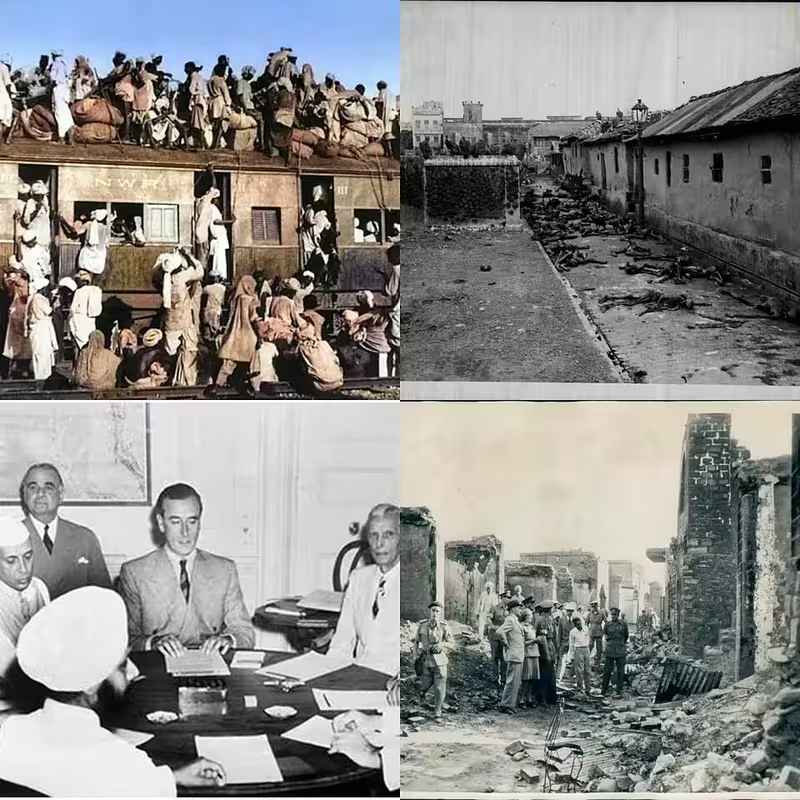
According to historical records, the partition would ultimately displace between 12 and 20 million people along religious lines, creating overwhelming refugee crises associated with mass migration and population transfer across the newly constituted dominions.
But on that August afternoon, Gurpreet and Rashid didn't know these numbers. They only knew that everything had changed, and nothing would ever be the same.
When Violence Came to the Fields
The violence, when it arrived, came like a fever—slowly at first, then all-consuming.
Gurpreet first heard the stories from refugees passing through. Massacres in Lahore. Trains arriving at stations filled with corpses. Villages burned. Women abducted. The numbers were incomprehensible, the brutality unimaginable.
"It won't happen here," people said. "We know each other. We're neighbors."
But fear is a contagion more virulent than any disease.
On August 23, armed mobs arrived from the east. Young men Gurpreet had never seen before, carrying swords and torches, shouting slogans about protecting Sikhs and Hindus. They demanded that Muslims leave for Pakistan immediately.
That night, Rashid came to Gurpreet's house in the darkness.
"We're leaving tomorrow," he said. His voice was steady, but his hands shook. "Taking only what we can carry."
"I'll protect you," Gurpreet said. "We all will. This is your home."
Rashid smiled sadly. "You can't protect us from this. No one can. The line has been drawn, yaar. Now we have to choose which side to die on—or which side to live on."
The next morning, Gurpreet stood at his door and watched as Rashid's family joined the long line of refugees heading west toward Pakistan. Bullock carts piled with possessions. Children crying. Old people who would never see their homes again.
The wheat in the fields—both sides of the border—stood ready for harvest. But there was no one to cut it now.
Disputed estimates of the loss of life during the partition varied between two hundred thousand and two million people. The violent nature of the partition created an atmosphere of hostility and suspicion between India and Pakistan that, as noted in historical accounts, would plague Indo-Pakistani relations for generations to come.
The Harvest That Never Came
In early September, Gurpreet made his decision.
The mobs had come twice more. His neighbor's house had been burned. Three Sikh families from the Pakistani side of the village had been killed trying to reach India. The border, instead of being a line on a map, had become a river of blood.
"We have to go," his wife Jaswinder said. She held their youngest daughter close. "Before it's too late."
Gurpreet walked through his fields one last time. The wheat had begun to fall, ungathered. Seeds that should have been food would return to the earth, wasted. He crossed the barbed wire—now guarded by soldiers on both sides—and walked into what was now Pakistan, to the seventeen acres that had been his.
The wheat there was falling too.
He had dreamed, briefly, of somehow harvesting both sides. Of claiming his full inheritance. But dreams die quickly in the face of reality.
They left at dawn, joining the great exodus. Millions of people moving in opposite directions—Muslims toward Pakistan, Hindus and Sikhs toward India—in one of the largest mass migrations in human history. The partition displaced between 12 and 20 million people, tearing apart the fabric of communities that had coexisted for centuries.
Gurpreet carried his daughter on his shoulders. His sons walked beside him, carrying what little they'd been able to pack. Behind them, the wheat fields stretched golden and abandoned, divided by wire and guarded by men with guns.
"Will we ever come back, Bauji?" Harjeet asked.
Gurpreet didn't answer. How could he explain that home wasn't a place you could return to anymore? That the Punjab they'd known—undivided, shared, whole—had ceased to exist at midnight on August 14, 1947?
What Remains
Years later, Gurpreet would tell his grandchildren about the wheat fields that straddled two nations. He would describe the golden harvest that never came, the friend he lost to a border drawn by a man who'd never walked through Punjab's soil.
He never saw Rashid again. Never learned if his friend's family made it safely to Pakistan, never knew if they found new land, planted new wheat, built a new life.
The Radcliffe Line remained, hardening from a hasty boundary into an international border, then into a militarized frontier. The wheat fields on both sides continued to grow, tended by different farmers now, yielding harvests that fed two separate nations.
Gurpreet settled in Amritsar, started again with a small plot of land. He taught his sons to farm, watched his grandchildren grow. But a part of him remained in those divided fields, standing at the barbed wire, watching the wheat fall unharvested.
The partition of India in 1947 was the division of British India into two independent dominion states, as set forth in the Indian Independence Act. But for people like Gurpreet Singh, it was something far more personal: it was the moment when a line on a map became a scar across the land, when neighbors became foreigners, when home became a memory divided by wire and fear and the terrible logic of religious majorities.
Sometimes, late in life, Gurpreet would wake from dreams of wheat fields. In these dreams, there was no border, no wire, no soldiers. Just endless golden grain, stretching to the horizon, whole and undivided, waiting for the harvest that would never come.
The partition displaced between 12 and 20 million people and resulted in disputed death toll estimates ranging from two hundred thousand to two million. The violent nature of the partition created an atmosphere of hostility and suspicion between India and Pakistan that continues to affect Indo-Pakistani relations to this day.